A high-pressure reading on your filter gauge is more than a minor technical note; it's a direct warning of an imminent system failure that could compromise your entire swimming season. It's incredibly frustrating to balance your chemicals perfectly only to see cloudy or green water staring back at you. When your equipment fails, you need a professional pool filter repair service Closter residents can depend on to restore clarity and safety. Whether you're dealing with a leaking multiport valve or a cracked filter tank, these issues require a technical eye to prevent more costly equipment damage.
You deserve a pool that runs quietly and efficiently without the constant stress of equipment malfunctions. In this guide, you'll learn how to identify specific filter failures and evaluate whether a targeted repair or a full equipment replacement is the most cost-effective choice. We'll also preview the local compliance standards, including NJ Administrative Code requirements for water circulation, that keep your backyard retreat safe. You're about to discover how expert diagnosis can transform your pool from a source of anxiety into a crystal clear sanctuary.
Key Takeaways
- Identify critical warning signs like persistent cloudy water and pressure spikes to prevent minor filter issues from becoming major system failures.
- Gain technical insights into the specific repair requirements for sand, cartridge, and DE filtration systems to ensure optimal water flow.
- Evaluate the cost-effectiveness of specialized repairs versus a full equipment replacement based on your unit’s age and efficiency.
- Discover why a professional pool filter repair service Closter is essential for managing local environmental factors like hard water and heavy Bergen County foliage.
- Learn how a comprehensive diagnostic approach ensures crystal clear water and quiet, dependable equipment operation all season long.
Recognizing the Signs: When to Seek Pool Filter Repair in Closter
Maintaining a pristine pool in Northern New Jersey requires more than just adding chlorine. Your filtration system is the heart of your backyard oasis. When it falters, the entire chemistry of your water shifts. If you've spent hours adjusting your chemicals only to find the water remains dull or hazy, your filter likely needs professional attention. Effective swimming pool sanitation relies on the physical removal of microscopic debris; without a functioning filter, your chemicals are fighting a losing battle. Recognizing these early warning signs can save you from a complete system failure. If you notice debris blowing back into the pool through the return jets, it's a clear signal that internal components have failed. This is the moment to contact a specialized pool filter repair service Closter residents trust to restore their water's clarity.
Visual and Auditory Warning Signs
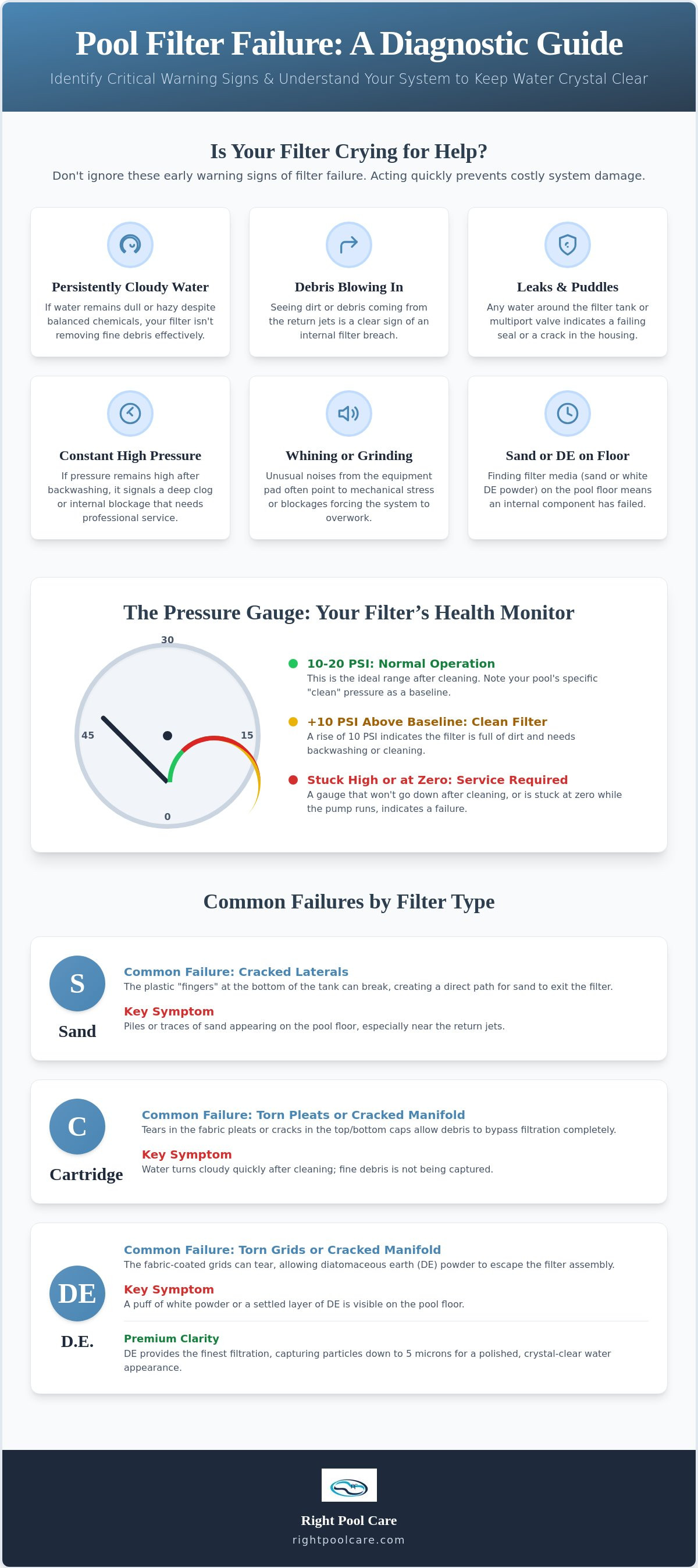
Don't ignore the physical state of your equipment pad. A small puddle around the filter tank or the multiport valve can quickly escalate into a flood that damages your pump's motor. Inspect the filter housing for hairline fractures; these often appear as thin, white lines on the tank's surface. Listen closely to the system while it's running. Whining or grinding sounds often indicate mechanical stress or a blockage that forces the system to work harder than intended. If you find sand or DE powder settling on the pool floor, you likely have a cracked lateral or a torn grid. These aren't just minor nuisances. They represent a breach in your system's integrity that requires immediate expert diagnosis to prevent a total equipment shutdown.
The Pressure Gauge: Your Filter’s Health Monitor
The pressure gauge is your filter's most honest communicator. For most Closter residential pools, the normal operating pressure sits between 10 and 20 PSI, though this varies based on your specific plumbing and pump size. You should establish a "baseline" pressure immediately after a deep cleaning or backwash. When the gauge rises 10 PSI above that baseline, your filter is struggling to breathe. If the needle remains high even after a thorough backwash, or if the gauge is stuck at zero when the pump is clearly running, the component has failed. Replacing a faulty gauge is a vital step in preventing future breakdowns. A reliable pool filter repair service Closter homeowners rely on will always check this gauge first to determine if the issue is a simple clog or a more complex internal failure.
Understanding Your System: Sand, Cartridge, and DE Filter Repairs
Every filtration system has its own mechanical personality and specific failure points. Whether your Closter home uses sand, cartridge, or DE technology, the filter acts as the primary barrier against contaminants. Proper filtration is a pillar of pool safety and health guidelines, ensuring that waterborne pathogens are effectively managed alongside your chemical regimen. When these systems fail, the circulation stops and the water stagnates. A professional pool filter repair service Closter homeowners trust can diagnose whether the issue is a simple seal or a complex internal structural failure.
Sand filters are the workhorses of the industry, but they aren't invincible. The most common failures occur deep within the tank at the lateral assembly. If these plastic fingers crack, you'll see filter media returning to the pool floor. It's a precision job. Cartridge filters rely on surface area. A tiny tear in the polyester pleats allows unfiltered water to bypass the system entirely. If the manifold, which is the plastic piece holding the cartridges together, cracks, the pressure will drop and your water will cloud overnight. Each system requires a different technical approach to ensure the water remains safe for your family.
DE Filtration: The Clear Water Standard
Many premier Bergen County estates choose diatomaceous earth swimming pool filtration for its ability to filter down to five microns or less. This provides a polished, glass-like finish to the water that other systems can't match. However, DE grids are delicate. A single tear in the fabric or a hairline crack in the top manifold will dump white powder back into your pool. Expert repair involves stripping the tank, deep-cleaning every individual grid, and inspecting for structural compromises that could lead to future breakdowns. It's the secret to maintaining that high-end aesthetic.
Multiport Valve and O-Ring Maintenance
The multiport valve is your system's control center. Inside, a component called the spider gasket keeps water from leaking into the waste line. If your valve handle is hard to turn, don't force it. This usually indicates the internal diverter needs lubrication or the gasket has become unseated. Brittle O-rings on the filter lid are often the silent culprits behind air bubbles in your return lines. These small seals are the first line of defense against suction-side leaks. If you're noticing persistent bubbles or a drop in flow, it's wise to have a professional restore your equipment’s performance before a small leak becomes a major flood. Our pool filter repair service Closter team specializes in these precision adjustments to keep your system running silently and reliably.
The Homeowner’s Dilemma: Repairing vs. Replacing Your Pool Filter
Deciding between a targeted repair and a full system replacement requires a clear understanding of how pool filtration systems work. You don't want to throw money at a failing asset. Conversely, you shouldn't discard a high-quality tank just because of a faulty valve. Our pool filter repair service Closter experts often see homeowners overwhelmed by these technical choices. We analyze the total system health before recommending a path forward. We prioritize your safety and the long-term clarity of your water over a quick, temporary fix.
A filter's age is the primary metric for this decision. Most residential filters have a service life of 10 to 15 years. If your unit is over 12 years old, the plastic components have likely become brittle from years of chemical exposure and UV rays. While replacing a manifold on an old DE filter might seem affordable, that money is often better spent on a new, high-efficiency model if the tank is nearing its end. Modern replacement systems offer superior flow rates. This reduces the strain on your pump and aligns with New Jersey’s push for energy-efficient equipment operation. A new system isn't just a purchase; it's an investment in a quieter, more dependable backyard experience.
When a Repair is the Smart Choice
If your filter is less than 8 years old, a repair is usually the most logical financial decision. Components like pressure gauges, air relief valves, and multiport gaskets are standard wear items. They're designed to be replaced. Swapping a torn cartridge or replacing the sand in a lateral assembly can restore your water clarity to like-new levels. This approach preserves your existing plumbing and avoids the labor costs associated with a full equipment re-configuration. We focus on these precise adjustments to maintain the value of your high-quality existing equipment.
Signs That Replacement is Inevitable
Some issues are non-negotiable. Any hairline crack in the filter tank itself makes the unit a safety hazard. These vessels operate under significant pressure; a structural breach can lead to a dangerous equipment failure or a flooded yard. If your current model is obsolete, finding specialized parts becomes an expensive and difficult task. Recurring failures are another red flag. If you've called for a pool filter repair service Closter technician multiple times in one season, the system has reached systemic fatigue. A full replacement provides the peace of mind that a patched-up unit simply cannot offer.
Local Expertise: Navigating Pool Filtration Challenges in Northern New Jersey
Closter's unique environment demands more than a generic approach to equipment care. The lush, wooded landscapes of Bergen County provide a beautiful backdrop but present specific challenges for your filtration system. High mineral content in local water often leads to "calcification." This occurs when calcium deposits harden on filter grids or cartridges, choking off water flow and forcing your pump to work harder. Our pool filter repair service Closter team understands these local nuances. We don't just fix a leak; we address the environmental factors that cause them. By understanding the seasonal dance of Northern New Jersey's climate, we ensure your equipment survives the transition from summer heat to winter frost.
Seasonal Impacts on Filtration
Spring in Northern New Jersey is a high-stakes moment for your pool's health. A meticulous pool opening service often reveals hidden damage from the harsh winter. If water wasn't completely purged during closing, the freeze-thaw cycle can crack internal manifolds or even the primary pressure vessel. Beyond winter risks, our area faces intense pollen counts and heavy organic debris from surrounding maples and oaks. These materials create a thick "mat" on your filter media, leading to the rapid pressure spikes we discussed earlier. Adhering to local standards, such as the Borough of Closter's Chapter 176 code, requires consistent water purity that only a local expert can guarantee.
Water Chemistry and Filter Health
Your filter's integrity is deeply connected to your water chemistry. High pH levels cause minerals to drop out of suspension, binding to your filter elements and reducing their efficiency. This is a common issue in Closter due to our local hard water profile. To extend the life of your equipment between service calls, keep your alkalinity balanced and clean your filter after any major storm or heavy bather load. This proactive maintenance prevents the "scaling" that ruins expensive DE grids and cartridges. If your water remains cloudy despite these efforts, request a professional equipment inspection to restore your system's performance and safeguard your investment.
Professional Equipment Service by Right Pool Care
Right Pool Care brings decades of technical mastery to every equipment pad in Closter and Alpine. We understand that your pool is a significant investment and a cornerstone of your family's summer memories. Our team approaches every service call with a no-nonsense attitude, focusing on physical results and long-term reliability rather than temporary patches. When you require a pool filter repair service Closter residents can trust, you need a partner who understands the intricate mechanics of your specific system. We maintain an extensive inventory of high-quality replacement parts for all major brands, ensuring that your repairs are completed with precision and speed.
Our diagnostic process goes far beyond the immediate symptom. A leaking valve or a high-pressure reading is often a sign of a deeper imbalance within your circulation system. We evaluate the entire equipment suite to ensure your pump and filter are perfectly synchronized. This comprehensive perspective prevents future breakdowns and ensures your water remains safe and inviting. The equipment pad is the silent conductor of your summer symphony; when it operates at peak efficiency, your backyard experience is truly transformed from a utility into a sanctuary.
Our Technical Repair Process
We follow a rigorous, step-by-step protocol to restore your system's integrity. Every service begins with a system-wide inspection to identify any underlying stress points in your plumbing. Our technicians perform precision repairs on multiport valves, DE grids, and internal manifolds using trade-specific tools and techniques. Once the internal components are secured, we conduct a final pressure test to guarantee a completely leak-free result. This methodical approach ensures that your pool filter repair service Closter is handled with the highest standards of safety and professional excellence.
Why Closter Homeowners Trust Right Pool Care
Our reputation in Northern Bergen County is built on dependable service and specialized expertise. We are equally proficient in servicing complex concrete pool systems and delicate vinyl liner configurations. We prioritize the security and health of your swimming environment, treating every repair as a critical safety task. By choosing a local specialist, you gain access to a team that is committed to the long-term vitality of your property. We value quality standards over quick fixes, ensuring that your equipment operates quietly and efficiently for years to come. Ready for crystal clear water? Schedule your filter repair with Right Pool Care today.
Secure Your Crystal Clear Water Today
Restoring your pool’s clarity requires a technical understanding of how filtration, local environment, and equipment age intersect. You've learned how to spot the early warning signs of failure and when a targeted repair is more strategic than a full replacement. By addressing issues like calcification and valve leaks before they escalate, you ensure a safe and inviting swimming environment for your family. A professional pool filter repair service Closter homeowners trust provides more than a quick fix; it offers the peace of mind that comes from expert diagnosis and precision execution.
Right Pool Care brings over 20 years of local industry experience to every project in Closter, Alpine, and Northern Bergen County. As specialists in high-performance filtration systems, we focus on long-term reliability and equipment safety. Don't let a malfunctioning filter compromise your summer season or lead to expensive secondary damage. Request a Professional Filter Diagnostic in Closter to restore your system's efficiency and enjoy the glass-like water clarity you deserve. Your backyard sanctuary is just one expert adjustment away from absolute perfection.
Frequently Asked Questions
How much does pool filter repair cost in Closter?
The cost of a pool filter repair service Closter depends on the specific components requiring attention and the labor time involved. Minor fixes like O-ring replacements or valve lubrications are relatively inexpensive compared to replacing a multiport valve or internal lateral assembly. Because every equipment pad is unique, we recommend a professional diagnostic to receive an accurate, comprehensive quote for your specific filtration needs.
How often should I clean or backwash my pool filter?
You should clean or backwash your filter whenever the pressure gauge reads 8 to 10 PSI above its "clean" baseline. For most residential pools, this occurs every 4 to 6 weeks during the peak swimming season. However, heavy storms or high pollen counts in Bergen County can accelerate this timeline. Regular monitoring of your gauge ensures your system maintains optimal flow and water clarity without unnecessary strain.
Can I repair a cracked pool filter tank?
No, a cracked pool filter tank cannot be safely repaired and must be replaced immediately. Filter tanks are pressure vessels that operate under significant force; any structural compromise like a hairline crack can lead to a catastrophic failure or property flooding. Attempting to patch a tank with epoxy is a dangerous temporary measure that ignores the underlying structural instability of the plastic or fiberglass.
Why is my pool filter making a loud humming noise?
A loud humming noise usually indicates an electrical issue with the motor’s capacitor or a mechanical failure in the pump’s internal bearings. While the filter itself doesn't hum, a clogged filter creates backpressure that forces the pump motor to work harder, leading to overheating and noise. If you hear this sound, shut down the system and request a professional inspection to prevent the motor from seizing entirely.
How long does a typical pool filter last in New Jersey?
A typical pool filter in New Jersey lasts between 10 and 15 years depending on maintenance and winterization quality. The harsh freeze-thaw cycles in Closter can stress plastic components, making them brittle over time. Consistent chemical balancing and professional winterization are the most effective ways to reach the upper end of this lifespan. Once a unit passes the 12-year mark, frequent component failures often signal the need for replacement.
What is the difference between backwashing and cleaning a filter?
Backwashing is the process of reversing water flow through a sand or DE filter to flush out trapped debris through the waste line. Cleaning involves the physical removal of cartridge elements or DE grids to manually rinse away fine particles and oils. While backwashing is a convenient routine maintenance task, a deep manual cleaning is still required at least once or twice a season to maintain peak filtration efficiency.
Can a dirty filter cause my pool pump to overheat?
Yes, a dirty or clogged filter is a primary cause of pool pump overheating. When the filter media is saturated with debris, it creates significant resistance that restricts water flow. This forces the pump motor to work at a higher temperature to move the same volume of water. If left unaddressed, this thermal stress can melt internal seals or lead to a permanent motor failure.
Do I need to replace the sand in my pool filter every year?
No, you do not need to replace the sand in your filter every year; most sand media lasts between 3 and 5 years. Over time, the sharp edges of the sand grains become rounded and smooth, which reduces their ability to trap fine contaminants. If you notice that your water remains cloudy despite long run times and frequent backwashing, it is likely time for a professional sand change to restore your system’s performance.