What if your backyard oasis is secretly hiding a repair bill that could cost 30% more than your annual upkeep? For many Northern New Jersey families, the transition from a frozen winter to a humid July often reveals cracks in the coping or equipment failures that were entirely preventable. You want a safe, hygienic place for your kids to swim without the headache of confusing chemical charts or the fear of Bergen County winter damage. We understand that your pool is more than just water; it's a miracle in the making for your family's summer memories. Establishing a professional pool maintenance service routine is the only way to ensure your liner and equipment survive the local climate for years to come.
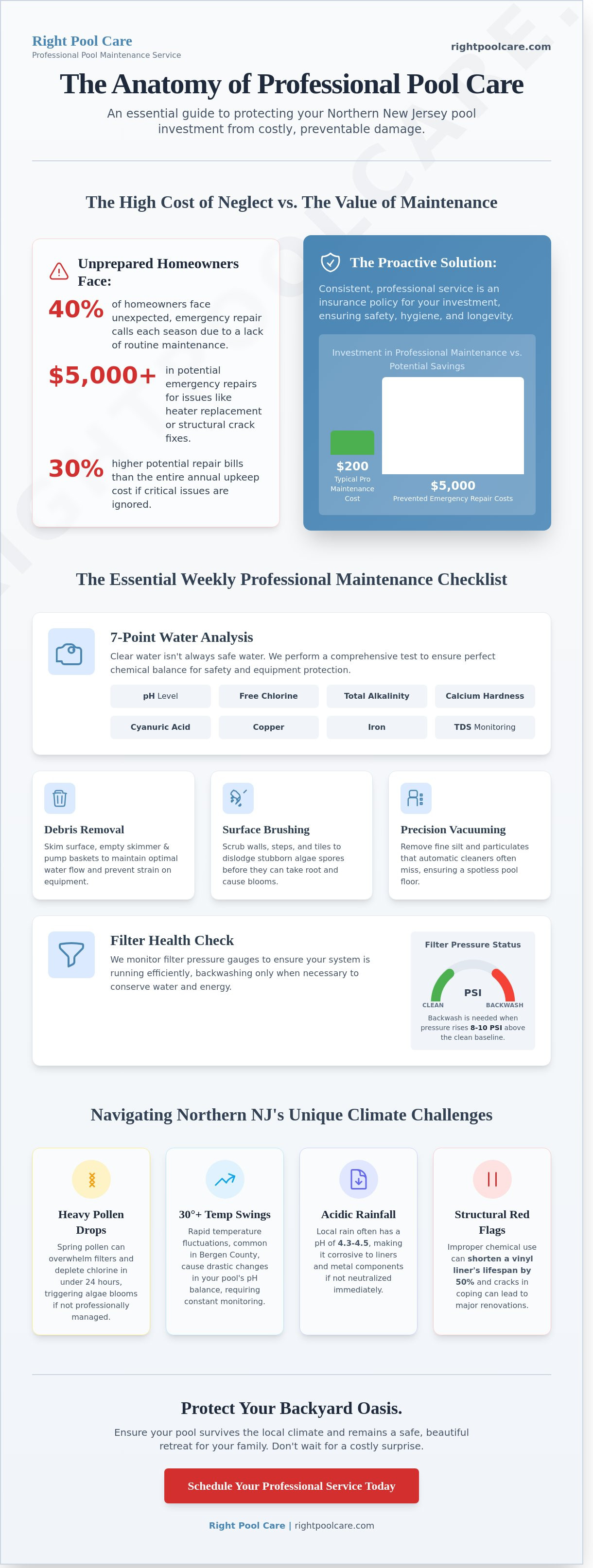
We agree that you shouldn't have to be a chemist to enjoy your own backyard. This guide provides the exact steps needed to master professional pool care and protect your property investment. At Right Pool Care, we believe in providing the peace of mind you deserve. You'll learn how to maintain perfect water clarity, extend the life of your safety covers, and avoid the emergency repair calls that plague 40% of unprepared homeowners each season according to recent industry data. We've broken down the essential tasks into a clear, actionable checklist designed specifically for our local environment.
Key Takeaways
- Protect your Northern New Jersey property value by understanding how the local climate impacts your pool’s chemistry and structural integrity.
- Master the 7-point water testing protocol and weekly cleaning routines that define a professional pool maintenance service.
- Identify early warning signs of hardware failure by learning how to evaluate the efficiency of your pump, motor, and filtration system.
- Navigate seasonal transitions with expert protocols for professional spring openings and mid-summer chemical adjustments during peak heat waves.
- Spot critical structural red flags, such as aging vinyl liners or coping cracks, to prevent minor leaks from becoming major renovations.
Why Professional Pool Maintenance Service Matters in Bergen County
Owning a pool in Northern New Jersey is a significant investment that requires more than a simple skimmer net. In premier towns like Alpine, Tenafly, and Closter, a pristine pool is a cornerstone of property value. Neglecting routine care leads to rapid deterioration. Professional pool maintenance service acts as an insurance policy for your backyard oasis. Industry benchmarks show that spending approximately $200 on consistent professional maintenance can prevent $5,000 in emergency repairs, such as heater replacements or structural crack fixes. We focus on long term results to ensure your "Miracles in the making" stay beautiful for decades.
Safety and hygiene are the most critical reasons to hire an expert. Clear water does not always mean clean water. Pathogens and bacteria can thrive in water that looks transparent but lacks proper chemical balance. We employ advanced swimming pool sanitation methods to ensure your swimming environment is free from contaminants. This technical precision protects your family from recreational water illnesses and keeps the water chemistry within safe, comfortable levels for skin and eyes.
NJ Environmental Factors: Pollen, Leaves, and Temperature Swings
The climate in Demarest and Norwood presents specific challenges for pool owners. During the spring, heavy pollen drops from dense wooded areas can overwhelm filtration systems in less than 24 hours. This organic load rapidly depletes chlorine levels; it triggers algae blooms if not managed by a professional pool maintenance service.
Temperature swings in the Northeast are equally volatile. A 30 degree shift in a single day is common in Bergen County; these fluctuations cause rapid changes in pH balance. Additionally, New Jersey rainfall is often acidic, frequently registering a pH between 4.3 and 4.5. Without immediate neutralization, this acidic water becomes corrosive. It aggressively attacks your pool liner and metallic components, leading to brittle surfaces and equipment failure.
Preserving Your Backyard Investment
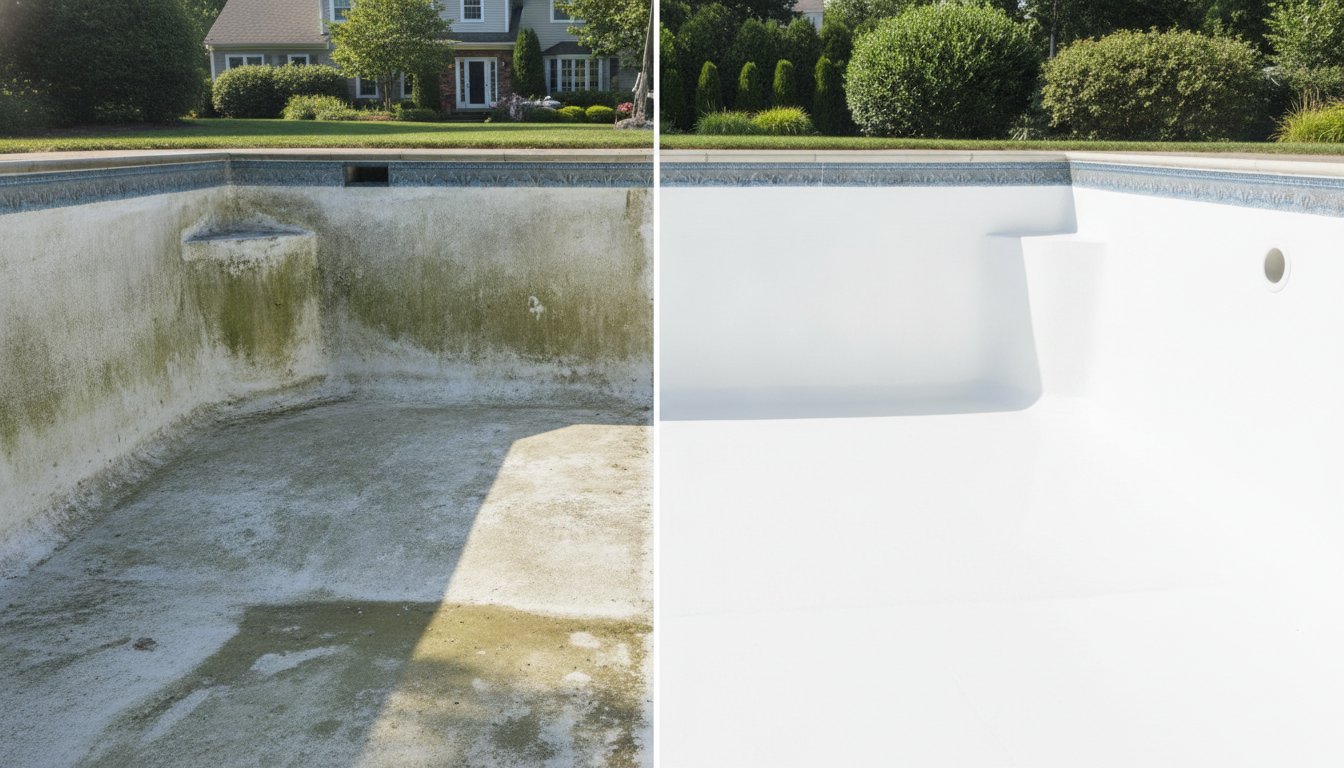
Professional chemical balancing is the only way to prevent premature vinyl liner fading. When chemicals are added incorrectly, they settle on the floor and bleach the material, which shortens the liner's lifespan by 50 percent. Our technicians monitor calcium hardness to protect your expensive heaters and pumps from scale buildup. Calcium scale acts as an insulator; it forces your heater to work harder and eventually causes the internal copper heat exchanger to fail.
Routine service also includes a visual inspection of all PVC piping and equipment seals. We look for minor leaks that the average homeowner might miss. Catching a small drip early prevents a massive washout. A subsurface leak can erode the ground beneath your pool deck, leading to a structural collapse that costs tens of thousands of dollars to remediate. We provide the expert oversight needed to keep your equipment running at peak efficiency.
The Essential Weekly Pool Maintenance Checklist
Consistency is the secret to a crystal clear pool. A professional pool maintenance service ensures your backyard remains a safe retreat rather than a chemistry experiment gone wrong. Our weekly routine follows a rigorous protocol designed for the specific climate challenges of Bergen County. This isn't just about appearances; it's about protecting your investment and your family's health.
- 7-Point Water Analysis: We test pH, free chlorine, total alkalinity, calcium hardness, cyanuric acid (stabilizer), copper, and iron.
- Debris Removal: We skim the surface and empty skimmer and pump baskets to maintain optimal flow.
- Surface Brushing: We scrub walls and tiles to dislodge algae spores before they take root.
- Precision Vacuuming: We remove settled silt and particulates that automatic cleaners often miss.
- Filter Health Check: We monitor pressure gauges and backwash the system once pressure rises 8 to 10 PSI above the baseline.
Advanced Water Chemistry Management
Clear water isn't always balanced water. You might see the bottom of the pool, but a low pH can still corrode your copper heat exchanger or etch your plaster. We monitor Total Dissolved Solids (TDS) closely. When TDS levels exceed 1,500 ppm, chemicals become less effective, often requiring a partial drain and refill to reset the baseline. We also shock the pool weekly. This process breaks down chloramines, the spent chlorine molecules responsible for that "pool smell" and eye irritation. Handling these high-strength oxidizers requires extreme care. The EPA chemical safety alert highlights the risks of fire and toxic vapors when chemicals are stored or mixed incorrectly. Our experts manage these risks to ensure your equipment and family stay safe.
Physical Cleaning and Debris Removal
Different surfaces require different tools. For vinyl liners, we use soft-bristle brushes to avoid abrasions. Concrete pools require stainless steel or stiff nylon brushes to penetrate the porous surface. We pay special attention to the waterline. Body oils and sunscreen create a sticky "waterline ring" that attracts dirt. We use specialized, liner-safe enzymes to dissolve these deposits without damaging the tile or coping. Finally, we verify water levels. If the water drops below the mid-point of the skimmer mouth, the pump can suck in air, leading to motor burnout. If keeping up with these technical details feels overwhelming, consider a professional pool maintenance service to keep your system running at peak performance.
Beyond the Surface: Technical Equipment and Hardware Inspection
Professional pool maintenance service involves a deep dive into the mechanical heart of your backyard oasis. It's about more than just clear water; it's about ensuring every component runs at peak efficiency to prevent costly mid-season failures. Right Pool Care experts focus on the hardware that keeps your water moving and sanitized. We listen for the subtle signs of wear that an untrained ear might miss. A grinding pump or a struggling heater can turn a weekend swim into an expensive repair if ignored. In towns like Closter, where the summer nights get cool, your heater needs to be in top shape to maintain that perfect 80-degree soak. Much like the home climate troubleshooting tips from RMI Heating and Air Conditioning, being proactive with pool hardware ensures year-round comfort.
Our technicians perform a rigorous inspection of your sanitization system. Salt cells require a manual inspection every 90 days to check for calcium scaling on the electrolytic plates. If buildup occurs, the cell's chlorine output drops, even if your control panel indicates everything is normal. We also verify the flow switch and temperature sensors to ensure your pool stays safe and bacteria-free all summer long.
Filter Maintenance: DE vs. Sand vs. Cartridge
Diatomaceous Earth (DE) filters provide the highest level of water clarity by capturing particles as small as 5 microns. To maintain this "Miracles in the making" level of water quality, we perform a full grid teardown and cleaning at least once per season. For sand filters, we look for "channeling." This occurs when water carves permanent paths through the sand media, allowing dirt to bypass the filtration process entirely and return to your pool. The optimal filter pressure range for standard residential pools is typically between 10 and 20 PSI depending on the specific plumbing configuration. If your pressure rises 8 to 10 PSI above its clean baseline, it's time for a backwash or a manual cleaning.
Pump and Motor Health
The pump is the engine of your pool. We inspect all seals and O-rings for signs of air leaks. If you see air bubbles dancing under the pump lid, your system has a suction-side leak that prevents proper priming and stresses the motor. We strongly recommend variable-speed pumps for NJ homeowners looking to improve energy efficiency. These units can reduce energy consumption by up to 90% compared to traditional single-speed motors. Identifying early signs of motor bearing failure is also a priority. A high-pitched whining or screeching sound is a clear warning that the bearings are worn. Replacing them early saves the motor, while waiting often leads to a total system replacement during the hottest week of July.
If you are also focused on maintaining your household appliances, you might find Hvidevaredele.dk helpful for sourcing hard-to-find spare parts, ensuring that all your mechanical systems remain in peak condition.
Seasonal Protocols: Pool Opening and Closing in NJ
New Jersey weather is famously unpredictable. You need a pool maintenance service that understands the transition from 90-degree July heat to 15-degree January freezes. Proper opening and closing protocols aren't just about convenience; they protect your investment from structural failure and costly PVC piping repairs. At Right Pool Care, we view every opening as the start of miracles in the making for your backyard.
The Spring Opening Process
Opening a pool in Bergen County requires more than just pulling back a cover. We follow a strict protocol to ensure your water is safe from day one. Our team focuses on four critical steps:
- Step 1: Pumping off and cleaning the winter cover. We remove standing water and organic debris to prevent contaminants from entering the pool.
- Step 2: Reinstalling deck equipment. We carefully reset all ladders, handrails, and lights to ensure they meet safety standards.
- Step 3: Initial heavy shock and phosphate removal. We use professional-grade concentrates to kill winter algae and lower phosphate levels below 100 ppb.
- Step 4: Mechanical system audit. We check every pump, heater, and filter for leaks before the system goes under full pressure.
During the peak of summer, we also provide mid-season check-ups. These visits are essential when heat waves or heavy bather loads deplete your chlorine levels and throw off your pH balance. We adjust your chemistry to handle the stress of the NJ summer sun.
Winterization and Safety Covers
Winter is the biggest threat to your pool's longevity. When water freezes, it expands by approximately 9 percent. This expansion can easily crack tile and coping or burst underground PVC lines. Our winterization process is designed to be fail-proof for the local climate.
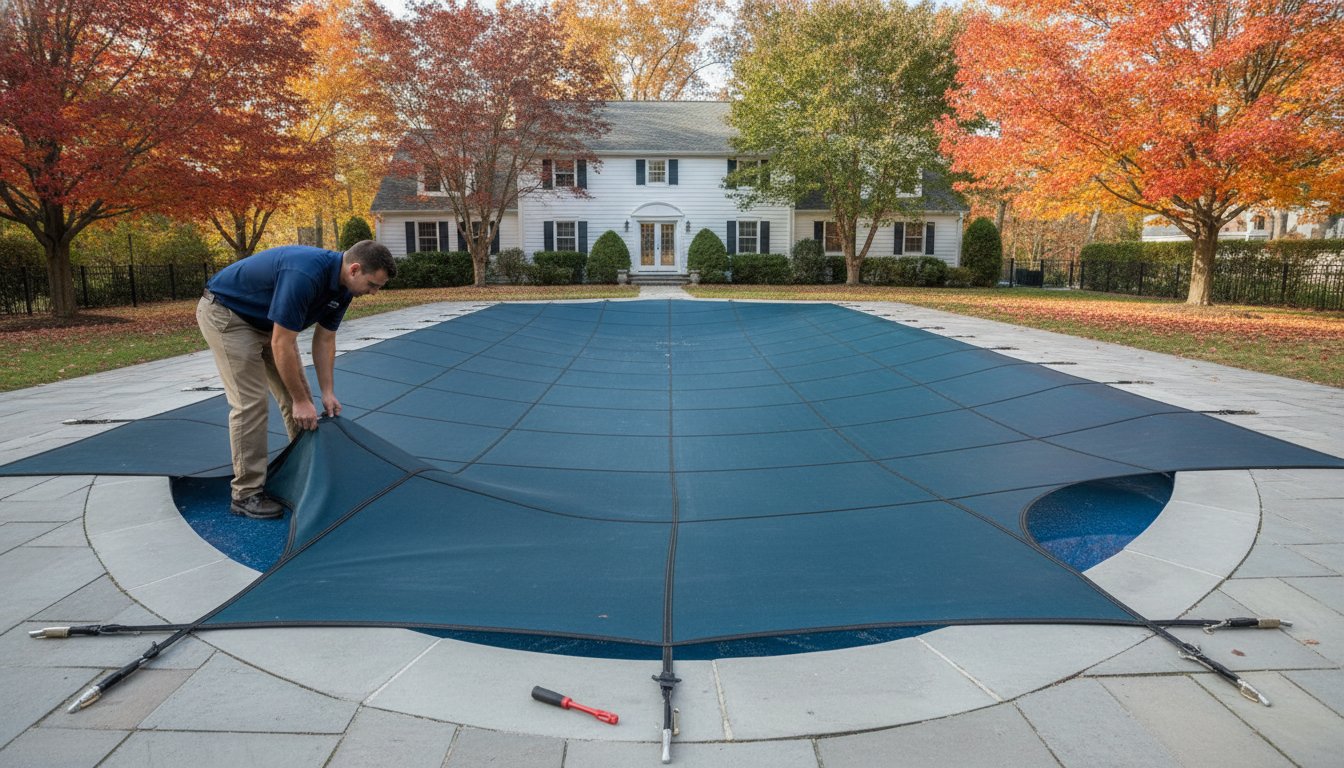
We use high-volume air compressors to blow out every line, ensuring no water remains to freeze and expand. Once cleared, we seal the returns with specialized expansion plugs. As Safety Cover Experts, we recommend custom-fitted safety covers for estates in Alpine and Tenafly. These covers are tensioned to support thousands of pounds, preventing accidents and keeping the water clear of debris.
Finally, we apply winter chemical kits. These contain long-lasting enzymes and sequestering agents that keep your water stagnant-free until the following May. It's the best way to prevent staining and scale buildup during the long off-season. We ensure your pool is protected so it's ready for another season of enjoyment.
When Maintenance Isn’t Enough: Identifying Structural Issues
Standard cleaning keeps water clear, but it won't stop structural decay. Homeowners often mistake a dropping water line for evaporation when it's actually a leak. If you're adding more than 2 inches of water weekly, your pool maintenance service needs to shift toward a structural audit. Ignoring these signs leads to expensive deck repairs and soil erosion that can compromise your entire property.
Liner and Masonry Warning Signs
Vinyl liners don't last forever. Most reach their limit after 12 years of Bergen County winters. If you notice these issues, your routine care routine must evolve into a renovation plan:
- Liner Pull: The material slips out of the track, usually at the corners.
- Brittle Edges: UV rays and chemicals make the top edge chalky and prone to snapping.
- Fading: Significant color loss often signals the vinyl has lost its plasticizers and flexibility.
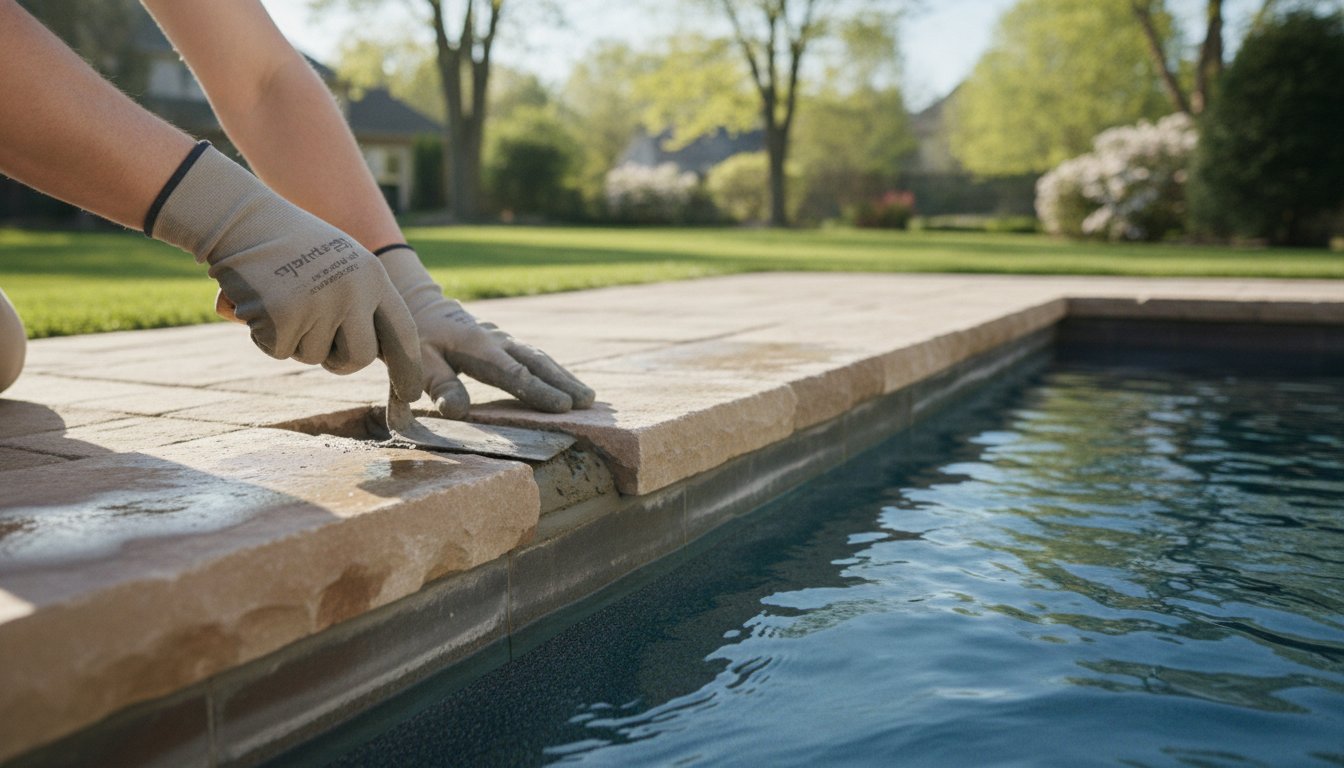
If you see these signs, seeking expert pool liner replacement Closter NJ is the smartest way to prevent a total washout of your pool's sand base. Masonry issues are just as critical. Loose coping stones aren't just a trip hazard. They allow water to seep behind the pool wall, which leads to deck instability and cracked concrete. If your tiles are falling off or the grout is missing, the bond beam is likely compromised and requires immediate professional attention.
The Right Pool Care Difference
We don't guess. Our team takes a no-nonsense approach to diagnosing whether your issue is a simple mechanical fix or a deep structural renovation. We've spent 20 years in Bergen County turning aging backyards into "Miracles in the making." We understand how local soil shifts and freeze-thaw cycles affect your pool's integrity. We provide clear, honest assessments so you don't waste money on temporary fixes.
Beyond repairs, we focus on long-term protection. We're safety cover experts. A custom-fitted safety cover provides peace of mind during the off-season. It prevents debris from entering the water and keeps families safe from accidental falls. Choosing the right partner means getting a solution that lasts another two decades. Don't settle for a patch when you need a professional restoration. We have the expertise to handle everything from equipment upgrades to full-scale masonry overhauls.
Secure Your Bergen County Backyard Oasis
Maintaining a pristine pool in Northern New Jersey involves more than basic cleaning. It requires technical precision and a strict seasonal schedule. From balancing chemical levels to inspecting PVC piping and hardware, a comprehensive approach prevents costly structural failures. Most homeowners find that professional pool maintenance service is the only way to guarantee water safety and equipment longevity throughout the year.
Right Pool Care leverages over 20 years of Bergen County expertise to provide reliable, high-level support for your property. We are established Safety Cover Experts and specialists in vinyl liner replacement and renovation. Our team focuses on the details that matter, ensuring every opening and closing is handled with professional care. We don't just fix equipment; we create miracles in the making by transforming stressed backyard spaces into life-enhancing retreats.
Don't let maintenance tasks overwhelm your summer. Schedule your professional pool maintenance service with Right Pool Care today! We're ready to help you enjoy a perfect, worry-free swim season.
Frequently Asked Questions
How much does professional pool maintenance service cost in NJ?
According to 2023 industry data from HomeAdvisor, New Jersey homeowners typically pay between $150 and $300 for a professional pool opening. Monthly maintenance costs generally range from $80 to $150 depending on the size of the installation. Right Pool Care provides custom quotes based on your specific equipment and water volume to ensure you receive the most accurate pricing for your property.
How often should a pool be serviced in Bergen County?
You should schedule a professional pool maintenance service at least once per week during the peak New Jersey swimming season. Bergen County properties often feature dense tree canopies that drop organic debris into the water daily. Weekly visits ensure your pH levels remain between 7.2 and 7.6, which prevents algae blooms and protects your pool liner from chemical damage.
What is included in a standard weekly pool service visit?
A standard visit includes skimming the surface, vacuuming the floor, brushing the walls, and emptying all skimmer and pump baskets. Our technicians test the water chemistry and adjust chlorine, alkalinity, and calcium levels to meet safety standards. We also perform a visual inspection of the filter pressure and PVC piping to ensure the entire system operates at peak efficiency without leaks.
Can I skip professional maintenance if I have a saltwater pool?
No, saltwater pools require consistent professional attention because the salt cell needs an acid wash every 90 days to remove calcium scale. While the generator creates chlorine, you must still balance stabilizer levels and monitor the pH, which tends to rise naturally in salt systems. Neglecting these tasks can lead to equipment corrosion and shorten the lifespan of your salt cell significantly.
What happens if I don’t maintain my pool chemicals during the winter?
Failing to balance chemicals before closing leads to liner staining and an expensive "green" opening in the spring. If phosphate levels exceed 500 parts per billion during the winter months, algae will bloom as soon as the temperature rises above 50 degrees. This often requires multiple shock treatments and extra filter cleaning sessions to resolve, which costs more than the initial winterization service.
How do I know if my pool pump needs repair or replacement?
You should consider a replacement if your pump is over 8 years old or if the motor makes a high pitched screeching sound. While we can often replace seals or O-rings, a new variable speed pump can reduce your pool's energy consumption by up to 90 percent. Right Pool Care experts evaluate your motor's performance to determine if a simple repair or a modern upgrade is the best choice.
Is it cheaper to maintain a pool myself or hire a professional service?
Hiring a professional pool maintenance service is often more cost effective because it prevents major equipment failures and structural damage. A 2023 industry study found that DIY owners spend 30 percent more on chemicals due to improper dosing and frequent over-correction. Our expert technicians catch small leaks in your tile and coping before they turn into major, expensive renovations.
Does a safety cover reduce the need for winter maintenance?
A safety cover significantly reduces debris entry, but it doesn't eliminate the need for winter chemical checks. As Safety Cover Experts, we recommend checking the water level and chemistry at least twice during the off season to protect your investment. Maintaining the proper chemical balance during the winter is the best way to ensure a miracle in the making when you open next spring.