Your pool's edge is the most critical square foot of your entire outdoor living space. It's the thin line between a relaxing afternoon and a preventable emergency room visit. Just as you take steps to avoid accidents at home, maintaining your family's wellness through experienced professionals like Colony Dental Care is an essential part of a proactive health strategy. We understand the anxiety that comes with watching children run on wet stone; you want a secure grip underfoot without your backyard looking like an industrial parking lot. Finding the right non-slip pool coping options shouldn't mean settling for surfaces that feel like sandpaper or look outdated.
While a residential pool area requires a much different aesthetic than a commercial facility, the commitment to safety is identical. For example, StripeGuys Warhouse Line Striping provides industrial-grade safety markings that ensure high-traffic floors remain secure, a principle that applies just as strongly to your pool's perimeter.
You deserve a perimeter that provides absolute peace of mind while elevating your home's aesthetic. This 2026 guide breaks down the high-traction materials that actually work in our demanding New Jersey climate. We'll examine how modern finishes like tumbled travertine, which stays up to 30% cooler than concrete, and frost-proof porcelain pavers offer superior slip resistance even when soaking wet. You will learn how to select materials that withstand the local freeze-thaw cycle and perfectly complement a new vinyl liner for a seamless, professional transformation.
Key Takeaways
- Identify why high-traction coping serves as the essential safety barrier between your pool and deck to prevent avoidable accidents.
- Compare top-tier non-slip pool coping options for 2026, focusing on materials like tumbled travertine and high-grip textured porcelain.
- Discover which stone and paver finishes are engineered to survive the intense New Jersey freeze-thaw cycle without cracking or shifting.
- Learn how to select the ideal edge profile, such as bullnose or cantilever, to complement your specific vinyl liner or concrete pool design.
- Understand the critical role of professional structural repair in maintaining proper drainage and ensuring your pool perimeter remains secure for years.
The Importance of Non-Slip Pool Coping for Home Safety
In the world of professional pool renovation, Coping is much more than a decorative border. It is the structural cap that finishes the top of your pool wall, acting as the vital "lip" between the water and the deck. While many homeowners view it as a finishing touch, its primary job is structural protection. It seals the bond beam, which is the concrete top of the pool wall, preventing water from seeping behind the pool shell or liner. In New Jersey, where the freeze-thaw cycle is relentless, a secure coping stone is your first line of defense against structural failure.
This same environmental pressure can also impact your home's foundation, making specialized services like foundationresq.com an essential resource for structural stabilization and long-term property health.
Traction is non-negotiable in high-traffic splash zones. When water settles on a smooth surface, it creates a thin film that eliminates the contact between a foot and the ground. This physical phenomenon is essentially hydroplaning. Polished stone or sealed concrete can become as dangerous as an ice rink the moment they get wet. Selecting high-quality non-slip pool coping options is the most effective way to disrupt this water tension. Textured surfaces provide the physical "teeth" required to maintain a secure grip even when the area is fully submerged.
Ensuring a slip-resistant perimeter is a vital part of a broader home safety strategy, particularly for families with seniors or individuals with disabilities. To learn more about how professional non-medical support can help maintain a safe and independent living environment, consider the resources provided by dedicated home assistance experts.
The need for reliable traction extends beyond residential pools to commercial recreational environments; for example, Aqua Play Parks engineers custom inflatable water park attractions with a focus on safety and durability for high-traffic waterfront venues.
Understanding Slip Resistance Ratings (COF)
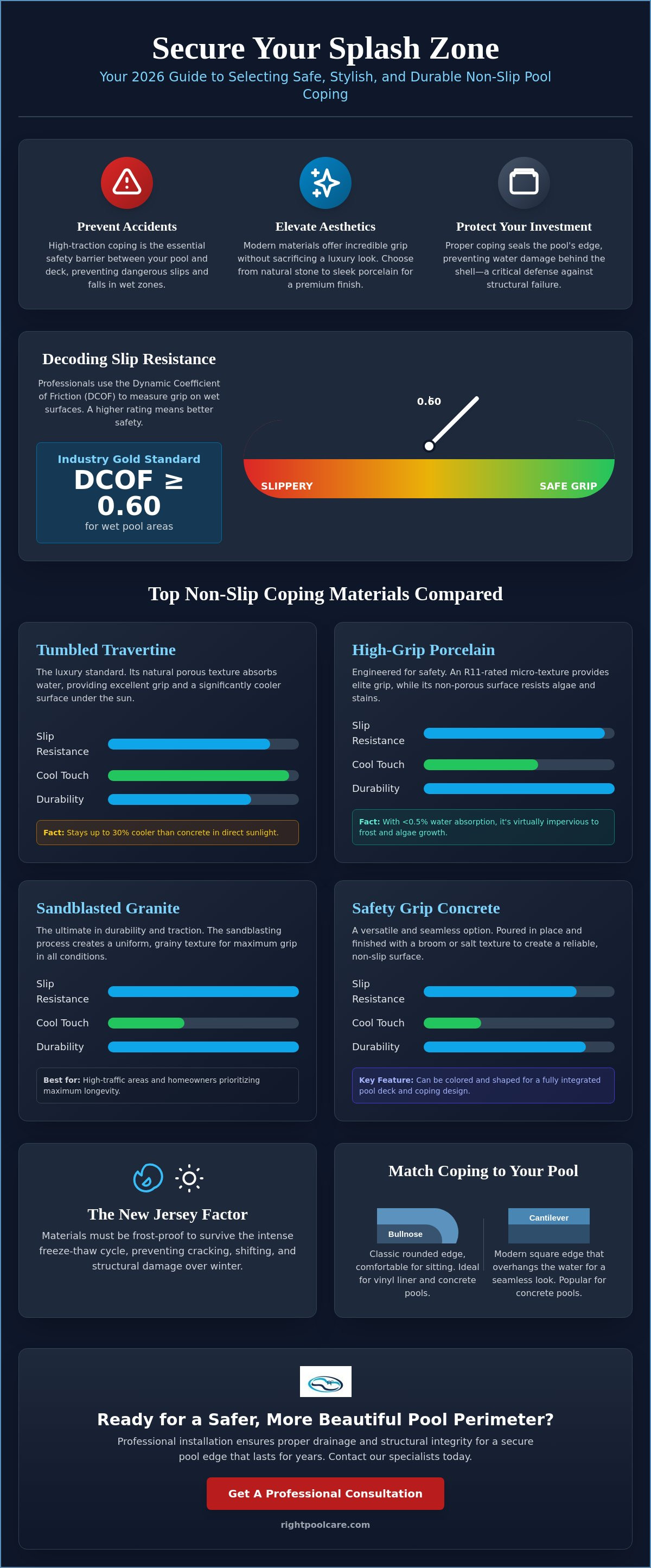
Industry professionals rely on the Coefficient of Friction (COF) to quantify how slippery a surface actually is. Static COF measures the force needed to start a slip, while Dynamic COF (DCOF) measures the grip while a person is already moving. For wet pool perimeters, a rating of 0.60 or higher is the recognized gold standard for safety. When you are evaluating non-slip pool coping options, always ask for the DCOF rating. This data ensures your material choice meets rigorous safety benchmarks rather than relying on a salesperson's guess.
Aesthetic vs. Functional Safety
We often hear the myth that "non-slip" surfaces must be rough, scratchy, or ugly. That is simply not true. Modern stone-cutting and manufacturing techniques allow for finishes that feel smooth to the touch but offer incredible grip when wet. Tumbled finishes or sandblasted textures provide a luxury aesthetic without the risk of a fall. You should also consider color choice for barefoot comfort. While dark charcoal tones are trending, they absorb significant UV heat. A lighter, textured stone offers a safer, cooler path for your family, and to ensure your pets are just as safe and well-behaved in your outdoor space, you can discover Pro-Dog K9 Academy.
Top Non-Slip Pool Coping Materials Compared
Selecting the right material for your pool's edge is a decision that balances physics with aesthetics. While visual appeal often drives the initial choice, the surface texture is what ultimately protects your family. Modern manufacturing and stone-cutting techniques have expanded the range of non-slip pool coping options, allowing for high-friction surfaces that remain comfortable underfoot and visually stunning. In 2026, the focus has shifted toward materials that offer consistent traction without the abrasive "sandpaper" feel of older safety products.
Natural Stone Options: Travertine and Limestone
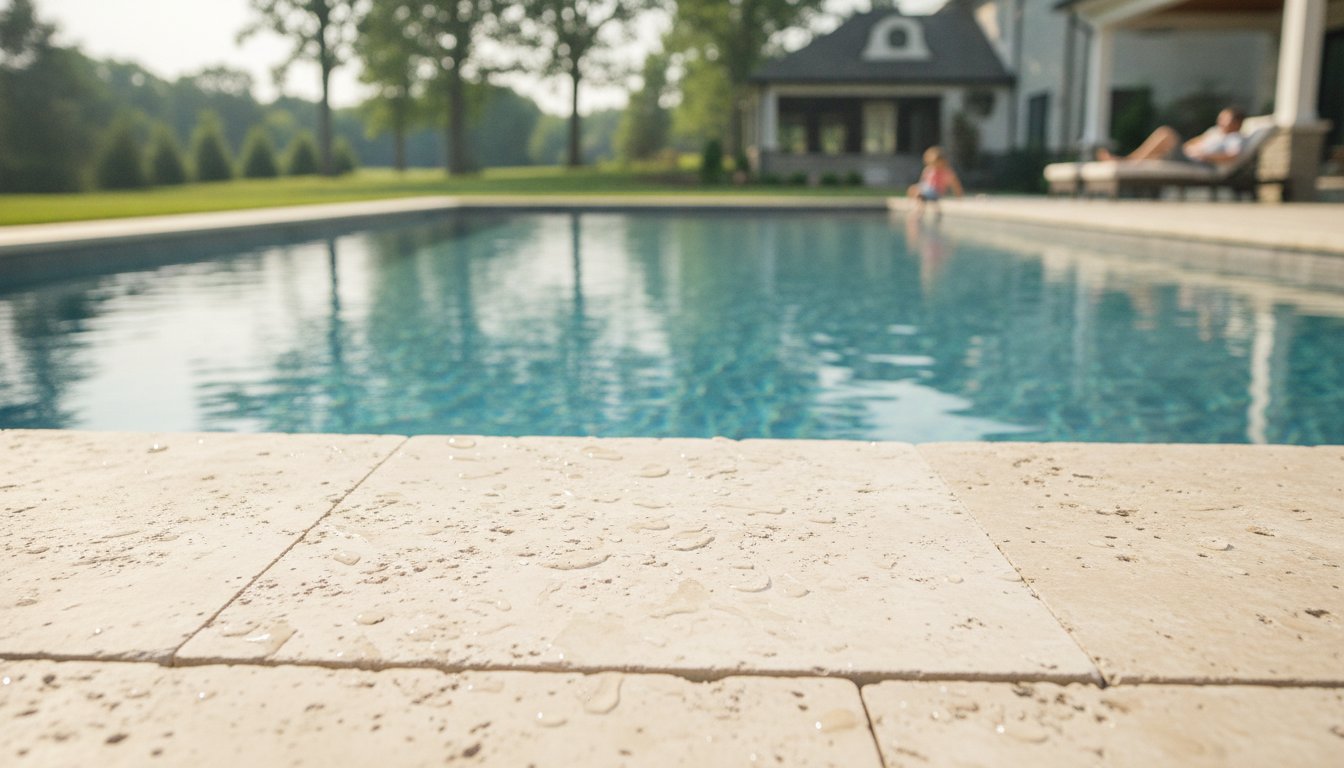
Travertine remains the industry standard for high-end residential pools. Its natural porous structure allows it to "breathe" and absorb water, which significantly reduces surface puddling. We specifically recommend tumbled or honed finishes for safety. Tumbled stone undergoes a mechanical weathering process that rounds the edges and opens the pores, creating a naturally slip-resistant texture. This finish is much safer than polished stone, which can become dangerously slick when wet. These stones also stay remarkably cool, often measuring up to 30% lower in temperature than concrete under direct sunlight. Adhering to CPSC safety guidelines for residential environments starts with choosing materials that provide reliable grip under various conditions. If your existing stone has become weathered or loose, our specialists can provide professional Tile and Coping Repair to restore the integrity of your pool perimeter.
Modern Porcelain and Slabs
The rise of R11-rated anti-slip porcelain has revolutionized pool design in 2026. These pavers are engineered with a specific micro-texture that provides elite grip levels even when fully submerged. Porcelain is nearly non-porous, with an absorption rate of less than 0.5%. This prevents the growth of algae and moss, which often create a slippery "slime" on other materials. Sandblasted granite is another premium choice for those seeking maximum durability. The sandblasting process creates a consistent, grainy texture that offers the ultimate in traction. For a more integrated look, safety grip concrete can be poured in place with custom broom or salt finishes. These non-slip pool coping options provide a versatile way to match your deck while maintaining a high safety standard.
- Travertine: Best for heat management and natural slip resistance.
- Textured Porcelain: Superior for low maintenance and algae resistance.
- Sandblasted Granite: The most durable option for high-traffic areas.
- Textured Concrete: Cost-effective and highly customizable.
The New Jersey Factor: Climate and Durability
Protecting a home in the Northeast requires materials that can withstand extreme temperature shifts. Just as Allesson Roofing provides robust solutions for residential exteriors, your pool's perimeter requires specialized materials to survive the local climate.
New Jersey homeowners face a unique set of environmental challenges that national retailers often ignore. In Bergen County, the relentless freeze-thaw cycle is the primary enemy of pool longevity and safety. When water enters the pores of a coping stone and freezes, it expands with incredible force. This internal pressure leads to a phenomenon known as spalling, where the surface layers of the stone flake away. Spalling transforms your beautiful perimeter into a series of sharp edges and uneven trip hazards. Selecting the right non-slip pool coping options for this climate requires a focus on density and extremely low water absorption rates.
Durability also extends to how your pool edge handles winter maintenance. Many homeowners don't realize that standard ice-melt products can chemically attack certain types of stone. Using the wrong de-icer on a low-density coping material can lead to rapid pitting and erosion. We prioritize materials that maintain their structural integrity and grip even after repeated exposure to winter chemicals. A safe pool perimeter must remain stable and functional for twelve months of the year, not just during the swimming season.
Winter Resilience for Closter and Alpine Pools
Density is your best defense against the elements. Materials like porcelain are virtually frost-proof because they don't allow water to penetrate the surface. For homeowners in Closter or Alpine, professional sealing is a requirement for any natural stone to prevent moisture from seating deep within the material. This extra layer of protection ensures that the stone's texture remains intact rather than crumbling under the weight of a New Jersey winter. Sandstone requires specific winter care in Northern NJ because its high porosity makes it susceptible to internal ice damage if left unsealed. By choosing high-density non-slip pool coping options, you reduce the risk of structural cracks that can lead to expensive bond beam repairs.
Safe Coping for Saltwater Systems
Saltwater conversions are a major trend in 2026, but they demand specific material choices to remain safe. Salt is naturally corrosive to soft, sedimentary rocks. Over time, salt air and splash-out can erode certain limestones, leaving them brittle and pitted. Porcelain and high-density granite are the top choices for salt pools because they are chemically inert and won't degrade under salt exposure. Proper drainage design is also essential here. Without the right pitch, salt can crystallize on the surface, creating a "slippery salt film" that reduces traction. Our installation process focuses on precise leveling to ensure water and salt residues wash away, keeping your high-friction surface clear and effective.
Beyond proper drainage, routine cleaning is vital for safety, and companies like Pressure Pros of Palm beach provide specialized exterior maintenance for decks and pavers to prevent the buildup of slippery films.
Maintaining the area around your pool often goes hand-in-hand with general property upkeep. For homeowners seeking high-quality exterior care, MMC Landscape provides professional landscaping and maintenance services that help preserve the beauty and safety of your outdoor environment.
Matching Coping to Your Pool Type
Your choice of pool edge is dictated as much by the pool's construction as it is by your personal style. A vinyl liner pool has different structural requirements than a traditional concrete shell, specifically regarding how the material interacts with the liner track. Modern non-slip pool coping options are designed to address these technical needs while providing a secure, high-friction transition from the deck to the water. Beyond aesthetics, the coping must be precision-leveled to ensure water drains away from the pool structure, protecting the bond beam from long-term moisture damage; this same level of attention to structural stability is a hallmark of expert commercial concrete contractors Conroe TX.
Just as pool coping protects the structural foundation of your pool, comprehensive property maintenance ensures the long-term health of your entire home; for expert construction and upkeep, you can visit Cardwell Property Services Inc..
Coping for Vinyl Liner Replacements
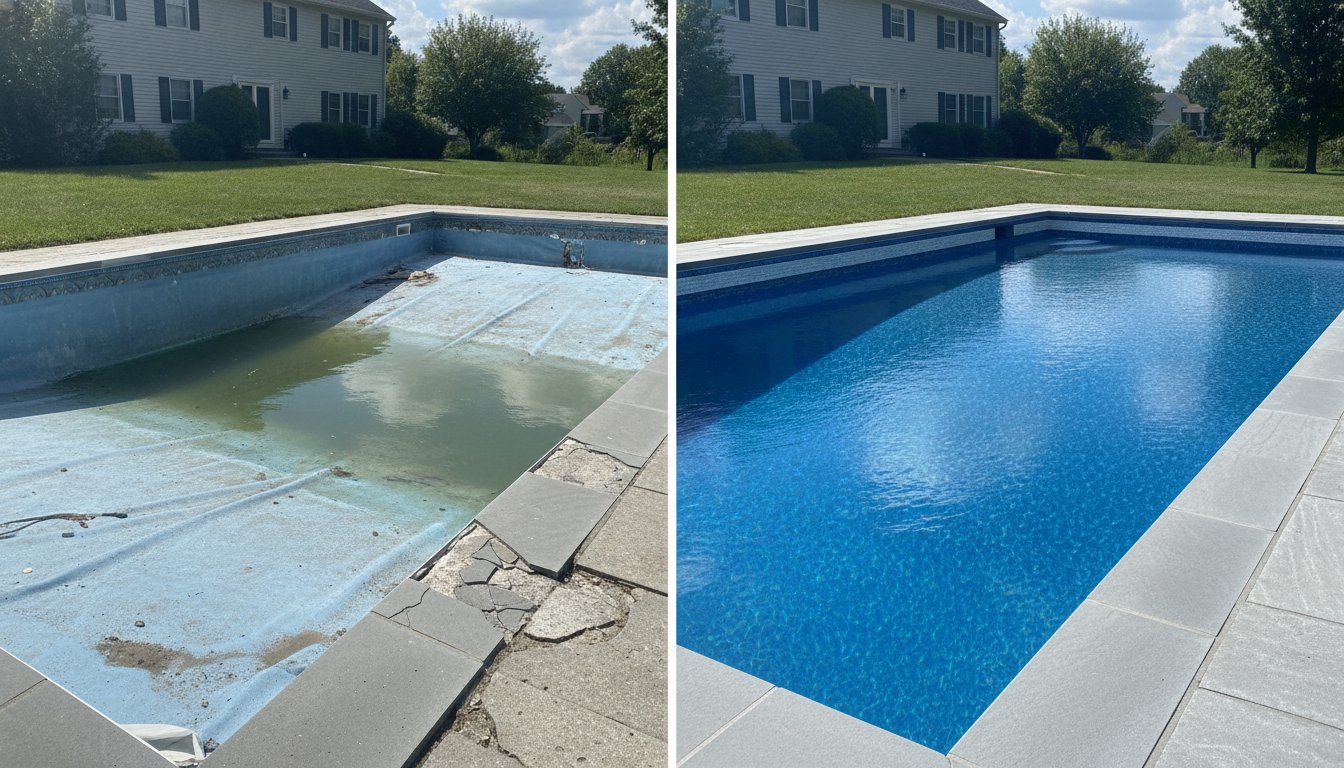
If you are planning a pool liner replacement Closter NJ, it's the ideal time to evaluate your coping. In vinyl pools, the coping often serves as the protective cap for the liner track. We recommend non-slip pool coping options with smooth, rounded edges that won't snag or wear the vinyl bead over time. Modern renovations frequently utilize cantilever or bullnose stone to completely hide the aluminum track, creating a seamless look that mimics a luxury concrete pool. Coordinating the stone's texture with your new liner pattern can transform a dated backyard into a cohesive, high-end retreat.
Profile Options: Bullnose vs. Square Edge
The profile of your coping stone changes both the safety profile and the visual weight of the pool's edge. Selecting the right shape is essential for balancing comfort with contemporary design. We typically install three primary profiles in New Jersey backyards:
- Bullnose: This classic rounded edge is the gold standard for safety. It's gentle on the legs when climbing out of the water and provides a comfortable grip for swimmers of all ages.
- Square Edge (Mitered): For a sleek, modern aesthetic, square-edged coping offers sharp, clean lines. When paired with textured stone, it provides elite traction while maintaining a minimalist look.
- Cantilever: This style involves a thicker stone that hangs slightly over the water's edge. It's a popular choice for creating a seamless transition from the pool deck, making the water appear as if it's integrated directly into the surrounding stone.
Whether you are building a new sanctuary or revitalizing an existing one, the right edge profile ensures your pool remains a safe, beautiful focal point. If your current liner is showing signs of age, consider a professional Vinyl Liner Replacement to perfectly match your new safety coping.
Professional Coping Installation and Repair
Installing a pool's perimeter is a task that demands millimeter-level precision. While many homeowners feel tempted by weekend DIY projects, improper installation often results in drainage disasters and compromised safety. We approach every project as a critical balance of structural engineering and aesthetic transformation. Selecting the best non-slip pool coping options is only half the battle; the installation method determines if those high-traction surfaces stay level and secure over time. Our technicians focus on creating a slight outward pitch, ensuring that chlorinated or salt water flows away from the pool shell and into the deck's drainage system.
This emphasis on structural precision is a hallmark of quality exterior work. Much like how SYNERGY ROOFING - ROOFING & SKYLIGHT SPECIALIST ensures that roofing and skylight installations are perfectly sealed and leveled to prevent leaks, professional pool coping requires an expert touch to maintain a safe, dry, and stable perimeter for your home.
When coping is improperly set, water can pool at the edge, creating the very slip hazards you are trying to avoid. Even the most advanced textured stone loses its effectiveness if it sits under a constant puddle. We ensure every stone is bedded in high-strength mortar and precision-leveled to prevent "toe-stubbers" or uneven edges. Integrating coping repair with a total pool renovation allows us to address the bond beam's health before the new stones are set. This commitment to structural longevity mirrors the standards of custom home builders like PRO Construction, guaranteeing a cohesive look and a foundation that remains unwavering against the elements.
Signs Your Coping Needs Immediate Attention
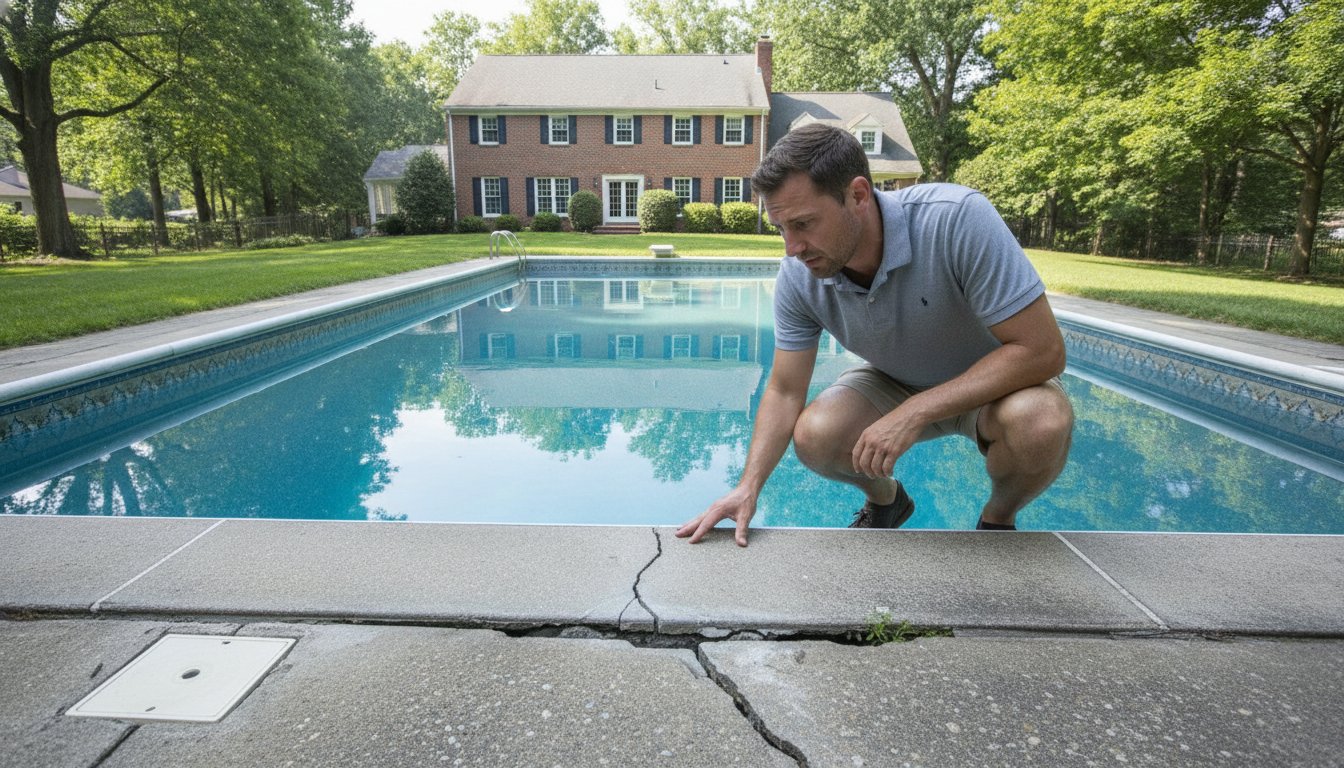
Your pool's edge often provides clear warnings before a total failure occurs. Ignoring these signs can lead to water seeping behind your liner or into the concrete shell, causing thousands in structural damage. Watch for these red flags:
- Loose or "Hollow" Stones: If you hear a hollow thud when walking on the edge, the mortar bond has failed. This stone is no longer a safety feature; it is a trip hazard.
- Cracked Grout Lines: Separations between stones allow water to infiltrate the bond beam. In Bergen County, this water will freeze and expand, forcing the stones to shift.
- Visible Heaving: If your coping appears higher than the surrounding deck, soil movement has likely pushed the structure upward. This requires immediate professional intervention to restore a level surface; in many regions, specialists like Airlift Concrete Experts use polyurethane injection to stabilize the ground and correct these types of structural shifts.
The Right Pool Care Process
Our process is designed to alleviate the stress of renovation while delivering a superior physical result. We begin with a detailed assessment of your current pool structure, helping you navigate the technical specifications of various non-slip pool coping options. From the initial material selection to the final safety testing, our team manages every detail. We serve homeowners throughout Alpine, Tenafly, and the surrounding communities with a commitment to quality standards that exceed the status quo. We don't just replace stone; we fortify your backyard sanctuary. Ready to secure your pool? Contact Right Pool Care for a professional coping assessment today.
Fortify Your Pool's Edge for Years of Safe Enjoyment
Your backyard is a place for joy and relaxation; it shouldn't be a source of safety anxiety. By choosing high-quality non-slip pool coping options, you are making a proactive investment in your family's security and your property's structural health. This same commitment to home protection is vital for your roof and gutters, where experts like Thoughtful Roofer Inc. provide specialized services to ensure long-term durability. We've explored how the right material density and texture can survive the harsh New Jersey freeze-thaw cycle while providing the elite traction required for wet environments. Whether you are matching a new stone profile to a vinyl liner or repairing a concrete bond beam, the technical details of the installation matter just as much as the material itself.
With over 20 years of Bergen County expertise, Right Pool Care understands the specific challenges facing homeowners in Closter, Alpine, and Tenafly. We are specialists in safety-first renovations that transform aging pools into dependable, beautiful retreats. Don't wait for a loose stone or a slick surface to cause an accident. Schedule Your Professional Coping and Liner Assessment today to ensure your pool perimeter is as resilient as it is stunning. Let's work together to create a secure sanctuary that stands the test of time.
Frequently Asked Questions
Is natural stone pool coping too slippery when wet?
Natural stone is only slippery if it has been polished or treated with a high-gloss sealer. Materials like tumbled travertine, flamed granite, or honed limestone are specifically processed to provide a high-friction surface. These finishes disrupt water tension and provide a secure grip for bare feet even in high-splash zones.
What is the most slip-resistant pool coping material available?
Textured porcelain with an R11 anti-slip rating and sandblasted granite are currently the top non-slip pool coping options for residential safety. These materials are engineered to maintain their grip levels even when fully submerged. Porcelain's low porosity also prevents the growth of slippery algae, keeping the perimeter clean and secure.
Just as low-porosity materials protect your pool's perimeter from moisture-related issues, professional basement waterproofing helps safeguard your home's interior from water intrusion; for expert assistance with structural health, click here.
Can I replace my pool coping without replacing the entire deck?
You can absolutely upgrade your coping as a standalone project without disturbing the rest of your pool deck. Our technicians utilize precision removal techniques to detach old stones while leaving the surrounding deck intact. This allows you to improve your pool's safety and style without the cost of a full backyard overhaul.
How much does it cost to install non-slip pool coping in New Jersey?
The total investment for your pool edge depends on the linear footage and the specific material you select. Factors such as the complexity of the pool's curves and the current state of the underlying bond beam will also impact the project scope. We recommend a professional on-site assessment to determine the exact requirements for your renovation.
While local renovation costs vary, the value of verified trade expertise remains a global standard; those interested in how professional experience is converted into formal qualifications can find more information at rightpathway.com.au.
Does salt water damage certain types of pool coping?
Salt water can cause significant erosion and pitting in softer, sedimentary stones like certain limestones or low-density sandstones. If you have a saltwater system, it's vital to choose high-density non-slip pool coping options like granite or porcelain. These materials are chemically resistant and won't degrade when exposed to salt splash-out or air.
How do I clean non-slip coping without ruining the texture?
Regular rinsing with fresh water helps prevent the buildup of minerals that can make surfaces feel slick. For those who prefer a professional touch to ensure their surfaces are cleaned safely, you can discover Warrens Power Washing and their specialized exterior care methods.
What is the safest coping profile for families with young children?
The bullnose profile is the safest choice for families because of its smooth, rounded edge. This design removes sharp corners that can cause scrapes or bruises during active play. The rounded shape also provides an easy, ergonomic grip for children's hands when they are climbing out of the water.
How long does a professional pool coping installation take?
A standard professional installation usually takes between three and five business days, provided the weather remains clear. This timeframe includes the careful removal of old materials, structural preparation of the bond beam, precision stone setting, and final grouting. Larger pools or those requiring complex custom cuts may require additional time for a perfect finish.