Drowning is the leading cause of death for children aged one to four in the United States. In a neighborhood like Old Tappan, where backyard oases are the standard, the off-season shouldn't be a source of constant anxiety. You've likely felt the frustration of wrestling with heavy, leaking water bags or the fear that a contractor might crack your expensive natural stone coping during a pool safety cover installation in Old Tappan. It's a high-stakes engineering project that requires more than just a drill and a tarp.
We understand that you want a winter-ready pool that meets strict NJ safety codes without sacrificing the aesthetic of your property. You deserve a solution that lasts over a decade, not a temporary fix that fails after two seasons. Discover how to secure your backyard with an ASTM-compliant safety cover that protects your family and preserves your custom deck's architecture.
This guide previews the specific 2026 local ordinances for the Borough of Old Tappan, including why a cover alone isn't enough to meet local barrier requirements. You'll also learn how A-B triangulation and CAD design create a precision fit that keeps your backyard looking clean and professional until spring arrives.
Key Takeaways
- Learn why a tension-engineered system meeting ASTM F1346 standards is the only way to truly secure your pool compared to standard winter tarps.
- Compare mesh and solid materials to determine which best handles Bergen County snow loads while minimizing your spring opening effort.
- Discover how professional pool safety cover installation in Old Tappan uses specialized drilling techniques to protect expensive natural stone and paver decks from damage.
- See how CAD measurements and A-B triangulation ensure a perfectly contoured fit for even the most complex custom pool shapes.
- Follow a seasonal maintenance schedule to maximize your investment and extend your cover's functional lifespan to 15 years or more.
The Critical Role of Pool Safety Covers in Old Tappan Homes
A custom pool is the crown jewel of an Old Tappan estate during the summer. However, it shouldn't become a source of anxiety once the temperature drops. Many homeowners mistake a standard winter tarp for a safety device. It isn't. A tarp is merely a thin veil held down by leaking water bags or concrete blocks. In contrast, a professional pool safety cover installation Old Tappan provides a tension-engineered barrier. These systems are designed to transform your pool from a seasonal hazard into a secure, architectural feature of your landscape.
Understanding ASTM F1346-23 Compliance
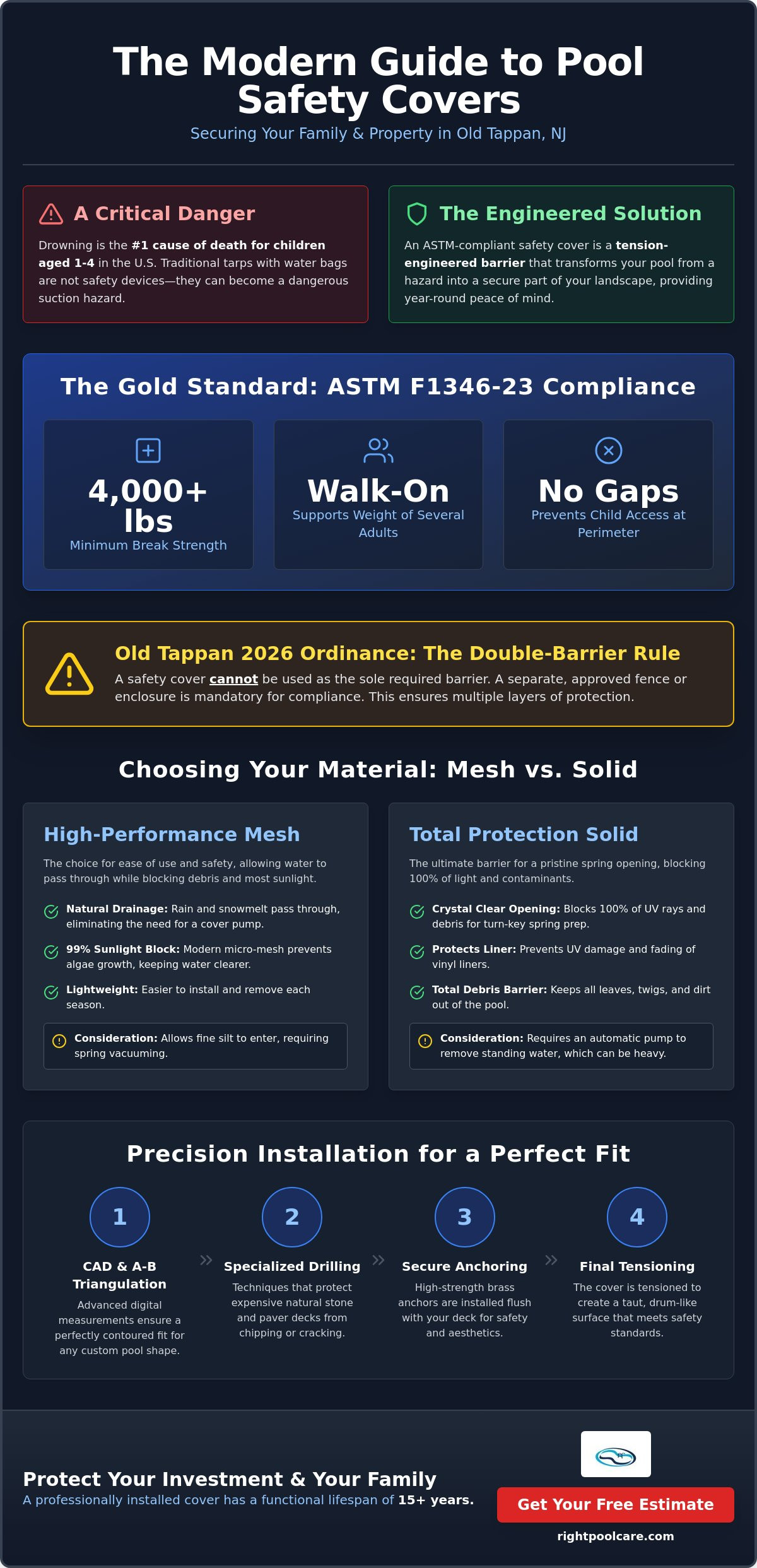
The ASTM F1346-23 standard is the industry benchmark for safety. To earn this certification, a cover must demonstrate a break strength of at least 4,000 pounds. This requirement ensures the system can support the weight of several adults or a wandering pet without failing. Professional installation is mandatory to maintain this compliance because of the "perimeter gap" rule. If the cover isn't tensioned perfectly, gaps can form that allow a child to slip underneath. Unlike traditional tarps that create a dangerous suction effect when rain accumulates, these systems remain taut and predictable throughout the harshest New Jersey winters.
Old Tappan Local Ordinances and Homeowner Liability
Local regulations in the Borough of Old Tappan are famously rigorous. Current 2026 ordinances dictate that a safety cover cannot be used as the sole required barrier for a pool; a separate fence or approved enclosure is mandatory. This local focus on security mirrors federal standards such as the Virginia Graeme Baker Pool and Spa Safety Act, which emphasizes the prevention of accidental drowning. Using a certified cover also has practical benefits for your umbrella insurance policy. many insurers view an ASTM-compliant pool safety cover installation Old Tappan as a critical mitigating factor for homeowner liability.
Securing your pool for 2026 is about more than just checking a box for a building inspector. It's about the psychological peace of mind that comes from knowing your backyard is "non-accessible" to uninvited guests or curious toddlers. There's a quiet dignity in a well-secured property. You can watch the snow pile up on your deck without the gnawing worry of what's happening beneath a sagging tarp. It's an investment in safety that pays dividends in confidence.
Choosing the Right Material: Mesh vs. Solid Covers for NJ Winters
Selecting a material is the most consequential decision in your winterization strategy. In Bergen County, we face a volatile mix of heavy, wet snow and rapid spring thaws. These conditions put immense strain on your anchoring system. Your choice between mesh and solid fabric determines whether you'll open a crystal-clear pool in April or spend weeks scrubbing algae. Both options must adhere to ASTM F1346 performance standards to ensure a pool safety cover installation Old Tappan provides the tension-engineered security discussed previously.
The Case for High-Visibility Mesh in Northern NJ
High-visibility mesh is the standard for most Old Tappan estates. Its primary advantage is drainage. Rain and snowmelt pass directly through the fabric, which prevents dangerous water accumulation on the surface. This eliminates the need for a cover pump. In 2026, micro-mesh weaves have advanced significantly. These newer fabrics block up to 99% of sunlight. This nearly eliminates the "green pool" syndrome traditionally associated with mesh covers. Because mesh is lighter, it's also easier to handle during the installation and removal process. However, the constant drainage means some fine silt will enter the water, requiring a more thorough vacuuming during your spring opening.
Solid Covers: Total Protection for a Crystal Clear Opening
Solid covers provide a total barrier against both debris and light. This is the preferred choice for homeowners who prioritize a "turn-key" opening. By blocking 100% of UV rays, these covers protect your vinyl liner from fading and ensure the water remains exactly as it was when the pool was closed. The trade-off is weight and maintenance. A solid cover requires an automatic pump to remove standing water. If the pump fails during a heavy NJ snowstorm, the weight of the water can overstretch your tension springs. Some owners prefer the "dry" method where the cover is kept perfectly clear of any liquid. This requires more vigilance but results in the cleanest possible water.
Regardless of the material, the success of the system depends on the quality of the tensioning. Heavy snow loads in Northern NJ can exert thousands of pounds of pressure on your deck anchors. If you're unsure which material fits your backyard's specific tree canopy and sun exposure, consulting a professional for pool safety cover installation Old Tappan ensures you get a custom-fit solution designed for longevity. Modern 2026 fabrics are built to resist chemical rot and UV degradation, but they only perform if the initial installation accounts for local topography.
Technical Precision: Anchoring Systems for Old Tappan’s Custom Decks
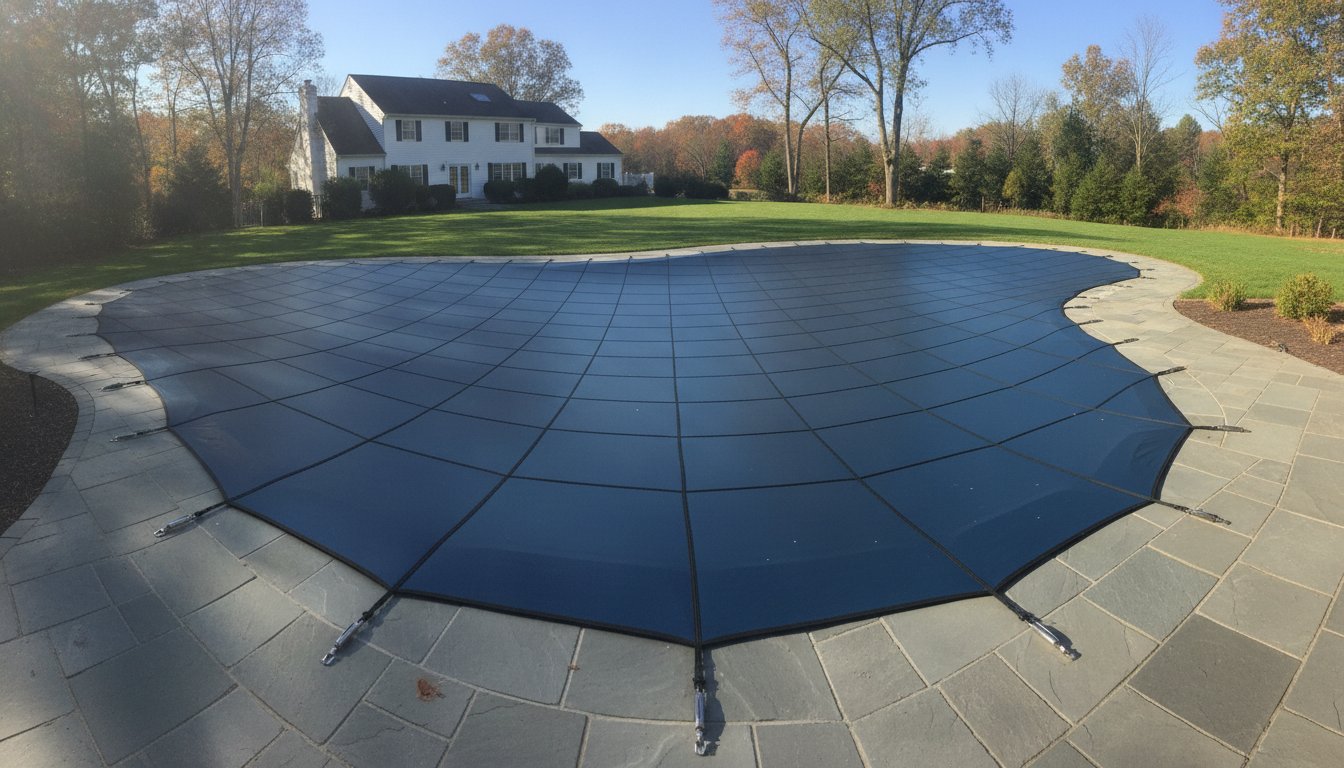
The integrity of your safety system depends entirely on how it connects to your property. A pool safety cover installation Old Tappan isn't a one-size-fits-all procedure. Your deck material dictates the specific hardware and drilling technique required to maintain tension. Whether you have poured concrete, intricate pavers, or imported natural stone, the anchoring system must be engineered to resist thousands of pounds of lateral force. We prioritize technical precision to ensure the cover remains taut without compromising the structural or aesthetic value of your backyard.
Homeowners often worry that drilling into a custom deck will ruin its appearance. We use recessed brass anchors that sit completely flush with the surface. When the cover is removed in the spring, these anchors are screwed down into their housings, effectively disappearing from sight. They won't stub toes or interfere with patio furniture. For maximum tension distribution, each anchor is drilled at a precise outward angle. This counteracts the inward pull of the heavy-duty springs, keeping the fabric drum-tight throughout the winter. These anchoring standards align with broader CPSC Safety Barrier Guidelines, which advocate for multi-layered protection to prevent unauthorized access.
Drilling into Natural Stone: Bluestone and Travertine
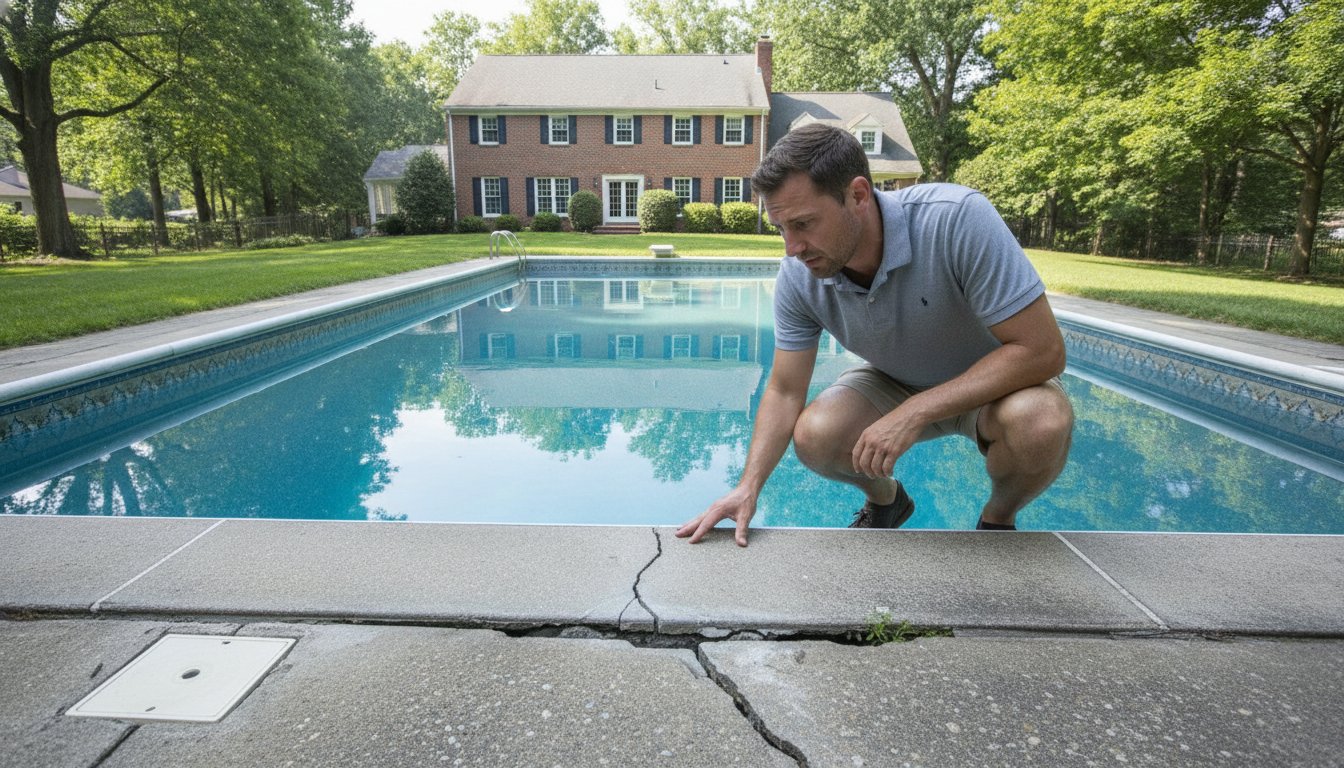
Old Tappan estates frequently feature high-end bluestone or travertine coping. These materials are beautiful but brittle. Standard masonry bits can cause spalling or large radial cracks that are impossible to hide. We utilize diamond-tipped core bits and specialized cooling systems to ensure every hole is surgical and clean. Managing dust and slurry is a priority; we protect your stone's finish by containing debris at the source. Anchoring into natural stone requires the surrounding substrate to maintain a structural integrity exceeding 3,000 PSI to prevent anchor pull-out during heavy snow loads.
Paver Decks and the Need for Pipe-and-Stake Systems
Paver decks present a unique challenge because the individual stones are set in sand rather than mortar. Standard anchors can loosen or "wiggle" over time as the pavers shift. To solve this, a professional pool safety cover installation Old Tappan utilizes 18-inch aluminum pipes. We drive these pipes through the paver and deep into the underlying soil. The anchor is then seated within the pipe. This engineering ensures the tension is anchored into the earth itself, not just the decorative surface. This method maintains a perfectly level profile and prevents tripping hazards caused by lifting pavers.
The Installation Process: From CAD Measurement to Final Tensioning
A professional pool safety cover installation Old Tappan follows a rigorous engineering timeline. It transforms a complex geometric challenge into a seamless safety barrier. Unlike generic retail covers, a custom-engineered system accounts for every curve of your pool's perimeter. The process ensures that the finished product isn't just a lid, but a tensioned shield capable of withstanding Northern Bergen County's winter extremes. This level of detail is what separates a reliable safety device from a simple pool topper.
Our technicians utilize point-to-point triangulation measurements. We plot dozens of specific coordinates around the pool deck to capture the exact shape of your pool. These data points are fed into Computer-Aided Design (CAD) software to create a digital blueprint. This precision eliminates the guesswork. It ensures that every stainless steel tension spring is positioned to deliver uniform force across the entire fabric surface. When the measurements are surgical, the final installation is flawless.
Step-by-Step Professional Installation Workflow
The journey from consultation to completion typically follows this structured path:
- On-Site Data Collection: We map the pool's unique footprint, including all features like ladders, handrails, and grab rails.
- CAD Blueprinting: The manufacturer uses our digital coordinates to laser-cut the fabric and reinforce high-stress points.
- Strategic Anchor Placement: We drill the deck according to the blueprint, ensuring each anchor aligns perfectly with the cover's straps.
- The Final Tensioning: We use specialized installation rods to snap the springs onto the anchors. The goal is a drum-tight fit that leaves no sagging material for debris to collect.
Custom Contouring for Advanced Water Features
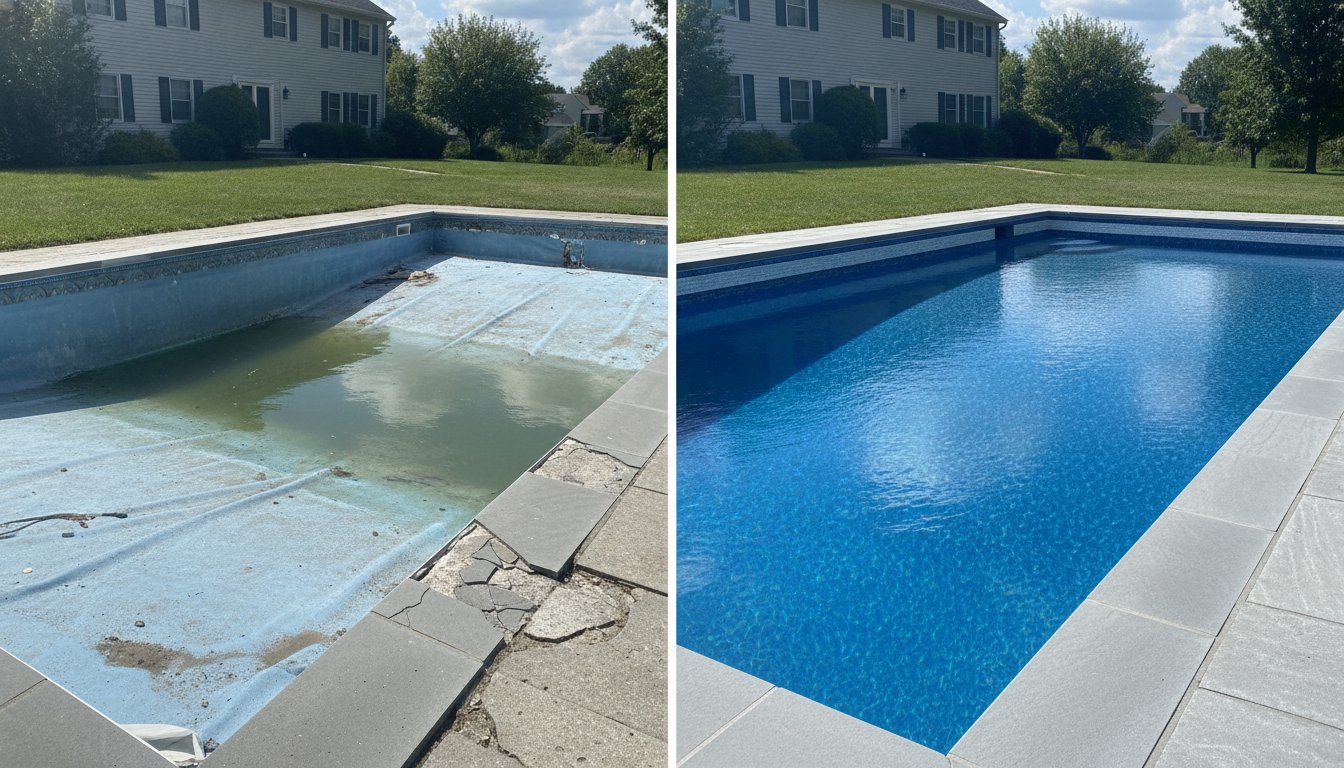
Old Tappan properties often feature elaborate rock waterfalls, raised spas, or decorative stone walls. These obstacles require up-and-over treatments or custom cutouts. For rock features, we integrate specialized padding to prevent the cover material from fraying against rough surfaces. If your project involves integrating the cover with existing pool repairs or coping renovations, the measurement phase must occur after all masonry work is finalized. This ensures the cover contours perfectly to the new stonework.
You should expect an initial stretch period. All new safety covers will expand slightly under their first heavy snow load. This is a natural characteristic of the high-tensile fabric. A follow-up adjustment is often necessary to re-tension the springs and maintain the system's safety rating. If you're ready to secure your backyard for the coming season, contact us to schedule your custom measurement and installation. Professional oversight ensures your system performs exactly as designed when the first storm hits.
Protecting Your Investment: Maintenance and Professional Support
A premium pool safety cover installation Old Tappan is a long-term commitment to your family's security. When engineered and maintained correctly, these systems can protect your property for 15 years or more. However, the harsh Bergen County climate requires a proactive approach to preservation. You shouldn't simply "set it and forget it" once the pool is closed. Consistent care prevents the accumulation of mold and fabric rot. This ensures your cover remains as resilient as the day it was installed.
Spring cleaning is the most critical phase for longevity. Before you store the cover for the summer, it must be thoroughly rinsed to remove chlorine residue and salt. Trapped chemicals can degrade the high-tensile fibers over time. We recommend a professional inspection during your scheduled pool closings to identify frayed straps or weakened springs. Catching these issues early prevents a total system failure during a mid-winter blizzard.
Winter Maintenance Tips for Old Tappan Homeowners
Active monitoring throughout the winter months is essential. While these covers are built for strength, they aren't indestructible. Keep these factors in mind to protect your system:
- Snow Accumulation: Monitor heavy snow loads. If the cover begins to sag excessively, carefully clear the accumulation to relieve pressure on the tension springs.
- Water Levels: Maintain the water level between 15 and 18 inches below the deck. If the water drops too low, the cover loses its buoyancy support and can overstretch the anchoring system.
- Hardware Checks: Inspect anchors and springs after high-wind events. Ensure every brass anchor remains seated and every spring is still under tension.
The Right Pool Care Difference in Bergen County
Your backyard is a sanctuary. Protecting it requires a local partner who understands the specific environmental demands of our region. Based in Closter, we're minutes away from your Old Tappan estate. This proximity allows us to provide a level of responsiveness that national firms can't match. We don't just install covers; we offer comprehensive solutions. Our team can integrate a pool safety cover installation Old Tappan with our broader swimming pool renovation services to ensure your entire outdoor space is cohesive, beautiful, and secure.
Don't leave your property's safety to chance this winter. Secure your home for the 2026 season with a system engineered for Bergen County's toughest conditions. We take pride in transforming technical construction into peace of mind. Contact us today to finalize your winterization strategy and protect the people who matter most.
Secure Your Old Tappan Oasis for the Seasons Ahead
A winterized pool shouldn't be a source of stress or an eyesore. By prioritizing pool safety cover installation Old Tappan that meets ASTM F1346 standards, you transform your backyard into a secure environment that protects your family and your high-end masonry. You've seen how precision CAD measurements and specialized anchoring for bluestone or paver decks ensure a drum-tight fit that lasts for 15 years or more. These engineering choices define the difference between a simple tarp and a true safety system.
With over 20 years of Bergen County expertise, we specialize in the technical nuances of natural stone and paver deck anchoring. We don't just install covers; we engineer peace of mind. Our team is ready to help you navigate the 2026 safety codes and select the ideal material for your property's unique landscape. Take the first step toward a worry-free winter today.
Request Your Custom Safety Cover Consultation in Old Tappan and ensure your pool remains a beautiful, secure asset for years to come. We look forward to helping you protect what matters most.
Frequently Asked Questions
Is a pool safety cover required by law in Old Tappan, NJ?
Yes, a pool safety cover is a critical component of your property's security, though local Old Tappan ordinances require it to be paired with a separate physical barrier like a fence. The 2026 local codes emphasize multi-layered protection to prevent accidental drowning. Using an ASTM-compliant cover ensures you meet the rigorous standards set by the Borough. It also helps manage homeowner liability by creating a "non-accessible" pool area during the off-season.
How much weight can a professional pool safety cover actually hold?
A professionally installed cover must support at least 4,000 pounds to meet ASTM F1346-23 standards. This capacity is designed to prevent accidents by supporting the weight of multiple adults or wandering pets. The strength comes from the tension-engineered fabric and the reinforced stainless steel springs. It's a structural shield, not just a lid, providing essential peace of mind during the heavy snow loads typical of New Jersey winters.
Can I install a pool safety cover myself to save money?
DIY installation is not recommended because it risks damaging your pool deck and compromising the cover's safety rating. Professional pool safety cover installation Old Tappan requires specialized diamond-tipped core bits and CAD-assisted measurements. A single misplaced anchor can lead to uneven tension or gaps in the perimeter. These errors often void the manufacturer's warranty and, more importantly, create a significant hazard for your family and pets.
What happens if my pool safety cover is installed on a paver deck?
Installing a safety cover on a paver deck requires a specialized pipe-and-stake system to ensure long-term stability. Standard anchors can loosen in sand-set pavers as they shift over time. We drive 18-inch aluminum pipes through the pavers and deep into the soil to provide a secure foundation. This engineering prevents the anchors from "wiggling" and keeps your deck surface level and safe for walking during the winter months.
How long does a custom pool safety cover installation typically take?
The entire process typically spans two to three weeks from your initial consultation. The measurement phase takes about an hour using point-to-point triangulation to capture your pool's unique footprint. Once the custom cover is manufactured using CAD technology, the physical pool safety cover installation Old Tappan takes four to six hours. This timeline ensures every anchor is surgically placed and the final tensioning is perfectly "drum-tight" before we finish the project.
Will drilling for anchors damage my expensive bluestone or travertine coping?
Professional installers use diamond-tipped core bits and water-cooling systems to prevent cracking or spalling on expensive natural stone coping. Standard masonry bits are far too aggressive for brittle materials like bluestone or travertine. By utilizing specialized equipment, we create surgical holes that house flush-mount brass anchors. These anchors effectively disappear when not in use, preserving the architectural beauty and finish of your custom pool deck.
Do I need a cover pump if I choose a solid safety cover?
Yes, an automatic cover pump is mandatory if you choose a 100% solid safety cover without a mesh drain panel. Standing water from rain or snowmelt creates a "suction effect" that can stress the anchoring system and create a drowning hazard. The pump automatically removes this accumulation to maintain the cover's tension. If you prefer a lower-maintenance option, consider a high-visibility mesh cover that allows water to drain naturally.
How do I know if my existing safety cover needs to be replaced in 2026?
You should inspect your cover for frayed straps, brittle fabric, or springs that no longer return to their original shape. If the webbing is thinning or the brass anchors have pulled loose from the deck, it's time for a replacement. Most high-quality systems last between 10 and 15 years. If your cover was installed before 2011, it likely lacks the advanced UV resistance and tensile strength of modern 2026 materials.