On July 12th, a homeowner in Alpine walked out to their backyard expecting a "miracle" swim, only to find a cloudy, green mess despite spending 4 hours balancing their chemicals. It's a common frustration in the 90% humidity of a North Jersey summer. You likely agree that wasting money on treatments that don't work is the quickest way to ruin a weekend. If you want to stop the cycle, you must learn how to reduce phosphates in pool water to keep your water safe and inviting.
The secret to a pristine swim isn't more chlorine. It's removing the food source that algae craves. We'll show you exactly how to master the science of phosphate removal to achieve "miracle" quality clarity that lasts. By following our expert steps, you can keep your Tenafly or Alpine pool crystal clear and algae-free all season long. This guide provides a professional blueprint to lower your chemical costs and protect your vinyl liner or concrete surface from recurring blooms.
Key Takeaways
- Understand why phosphates act as "algae fuel" and how they can compromise your water clarity even when chlorine levels are optimal.
- Protect your investment by learning how high phosphate levels lead to aggressive algae blooms that can permanently stain vinyl liners.
- Master our expert 5-step action plan on how to reduce phosphates in pool water to ensure your Alpine or Tenafly oasis stays crystal clear.
- Distinguish between "low" and "critical" phosphate levels using professional-grade testing methods rather than unreliable standard test strips.
- Gain the Right Pool Care advantage by using concentrated professional treatments that outperform diluted big-box store chemicals.
Understanding Phosphates: Why They Are the "Algae Fuel" of Bergen County Pools
Phosphates are naturally occurring organic compounds, specifically orthophosphates, that function as a high-powered fertilizer for your pool. If you have ever wondered why your water looks dull despite having "perfect" chlorine levels, phosphates are likely the culprit. They act as a silent killer of water clarity by providing the exact nutrients algae need to survive and multiply. Understanding how to reduce phosphates in pool water is the first step toward maintaining a truly pristine swimming environment.
In Northern NJ, we see this phenomenon play out every summer. This nutrient loading is identical to the process of eutrophication seen in local ponds and lakes, where excess minerals cause sudden, uncontrollable plant growth. In a swimming pool, this translates to slippery walls and a constant demand for more chlorine. It's important to clarify that phosphates do not actually kill algae. Instead, they make it nearly impossible to starve the algae out. When phosphate levels are high, even a small drop in chlorine can lead to a full scale bloom within hours.
Bergen County homeowners in towns like Alpine and Tenafly face a unique uphill battle. The lush landscaping and heavy tree cover that make these neighborhoods beautiful also contribute to massive phosphate spikes. When you are surrounded by century old oaks and maples, your pool is constantly collecting organic debris that breaks down into these stubborn compounds.
Common Sources of Phosphates in Northern NJ
- Lawn Fertilizers: Many local landscaping services use phosphorus-rich fertilizers to maintain the deep green lawns common in Bergen County. Heavy NJ rainstorms wash these chemicals off the grass and directly into your pool water.
- Organic Decay: Decaying leaves, twigs, and pollen from local oaks and maples are primary contributors. Even if you use a robotic cleaner, microscopic organic particles remain and decompose.
- Municipal Water: Some NJ water sources use polyphosphates to prevent pipe corrosion in older infrastructure. This means every time you top off your water level, you might be adding more "algae fuel" to the system.
The "Scam" Myth: Why Phosphate Management is Essential in 2026
You may find older advice on forums like Trouble Free Pool suggesting that phosphate removers are a "pool store scam." Back in 2006, when environmental phosphate loads were lower, you could often get away with ignoring them if your chlorine was high enough. However, the environment in 2026 has changed. Increased humidity and higher concentrations of runoff mean that modern pools face much more pressure than they did 20 years ago.
Relying solely on chlorine to "overpower" high phosphates is expensive and inefficient. Managing these levels is a proactive strategy that saves money on shock and specialty chemicals. "While chlorine is your sanitizer, phosphate management is your insurance policy against the NJ summer humidity." By removing the food source, you ensure that your chlorine can focus on its primary job: keeping your family safe from bacteria and pathogens.
The Hidden Danger: How Phosphates Impact Vinyl Liners and Pool Surfaces
Phosphates are more than just a number on a water test strip. They act as a high-energy fertilizer for algae. When phosphate levels rise above 500 parts per billion, your pool becomes a breeding ground for biological growth. This nutrient load is the primary reason why homeowners struggle with recurring green water. Understanding how to reduce phosphates in pool systems is critical for protecting your investment. High levels lead to aggressive blooms that don't just float on the surface. They anchor themselves to your pool walls.
Algae "roots" can cause permanent staining on vinyl liners. These stains are often impossible to remove without damaging the material. According to The Science of Starving Algae, removing these nutrients is the most effective way to break the cycle of chemical dependency. If you ignore the phosphate count, you'll spend hundreds of dollars on chlorine that simply disappears as it fights a losing battle against rapid algae reproduction.
Staining and Structural Damage
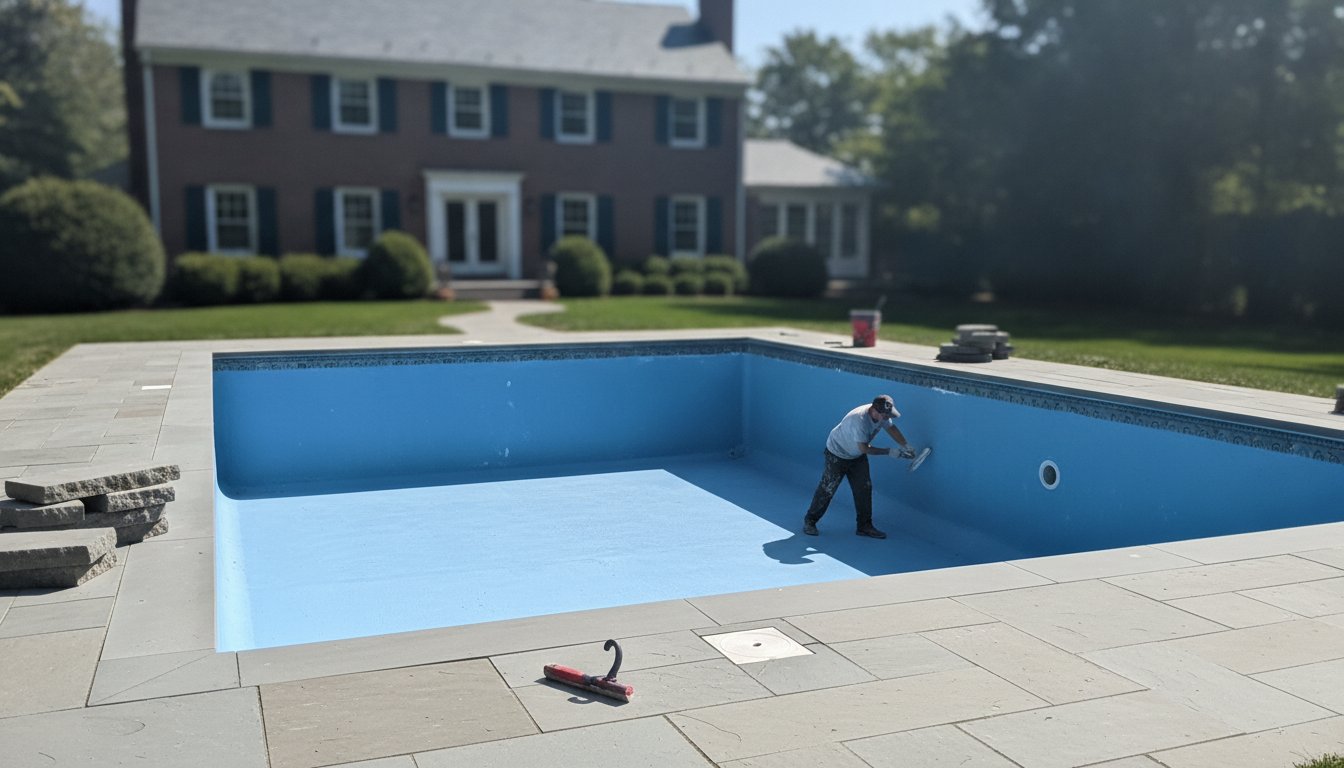
Mustard and black algae thrive in high-phosphate environments. These specific strains are notoriously difficult to kill. They find microscopic pores in your pool surface and settle in. To eliminate them, you often have to "shock" the water with massive doses of chlorine. This chemical spike is harsh. It accelerates the fading of your liner and can weaken the structural integrity of the material over time. In local areas like Tenafly and Cresskill, we often see gunite pools that require an intensive acid wash because severe phosphate issues led to deep, systemic staining. This process is effective but invasive. It's a reminder that the cost of prevention is always lower than the cost of a cure.
Vinyl Liner Longevity and Phosphates
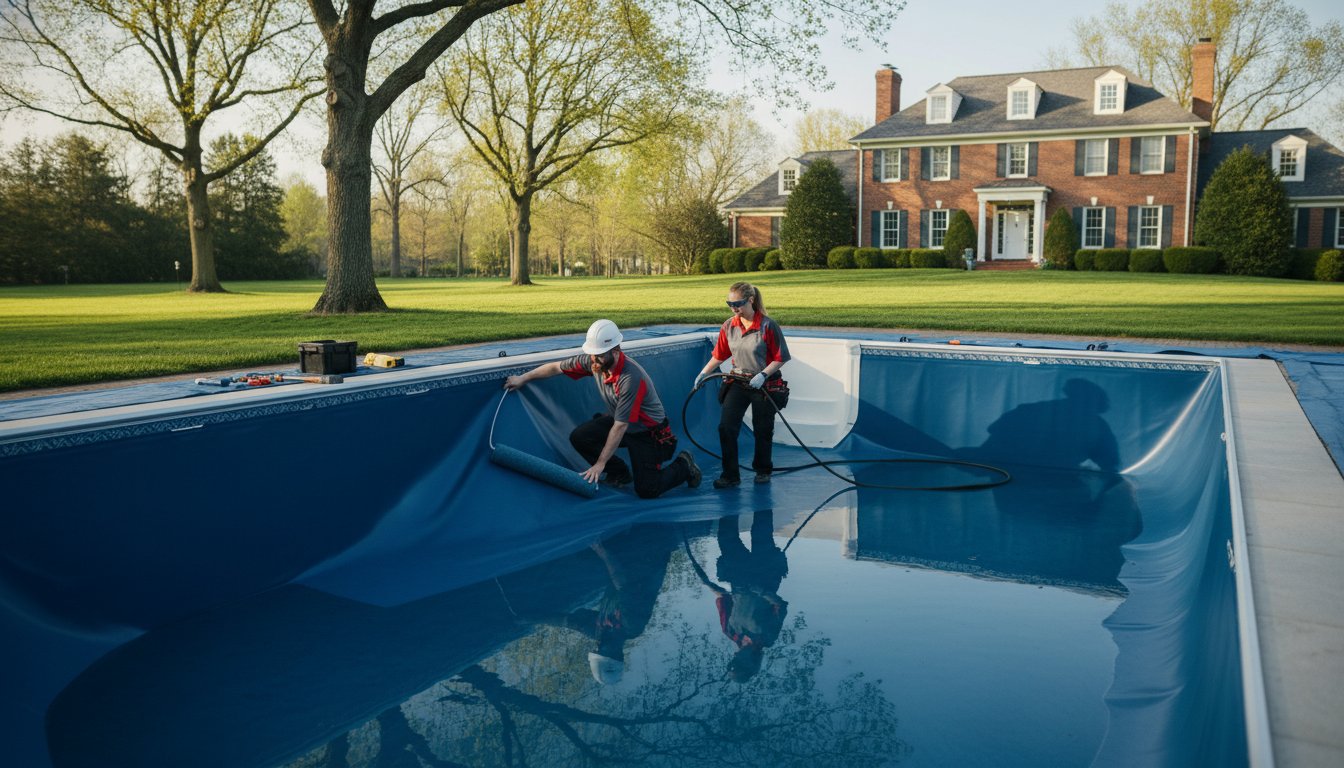
Your vinyl liner has a typical lifespan of 10 to 15 years, but high phosphate levels can cut that time in half. Organic buildup creates a film that traps heat and chemicals against the vinyl. This leads to brittleness and premature cracking. If your water chemistry is constantly out of balance, you'll likely need a pool liner replacement Closter NJ years before it's actually due. Clean water chemistry is what preserves the "Miracles in the making" aesthetic that defines a luxury backyard.
By keeping nutrients low, you avoid the heavy scrubbing and aggressive treatments that wear down your pool's finish. It's the difference between a simple seasonal update and a full swimming pool renovation Bergen County. Our team at Right Pool Care recommends consistent testing to ensure your levels stay within the safe zone. Learning how to reduce phosphates in pool water today prevents the structural headaches of tomorrow.
Testing and Thresholds: When Should You Actually Use a Phosphate Remover?
You don't need to panic every time a test shows a trace of phosphates. Understanding the difference between low and critical levels saves you money and prevents unnecessary chemical imbalances. Standard test strips are convenient for a quick check, but they often lack the precision needed for parts per billion (ppb) measurements. These strips might show a color change, but they won't tell you if you are at 300 ppb or 800 ppb. For an accurate reading, use professional liquid reagents. These tests provide the granular data required to decide how to reduce phosphates in pool water effectively without guessing.
Right Pool Care experts recommend testing your phosphate levels at least once a month during the peak New Jersey swimming season. Over-treating your water when levels are manageable is a common mistake. If your chlorine is holding steady and the water is crystal clear, a reading of 200 ppb doesn't require immediate chemical intervention. Chasing a zero reading is often a waste of resources. Focus on the 500 ppb threshold as your primary action point to maintain a healthy environment.
How to Read a Phosphate Test Result
- 0-200 ppb: This is the ideal range for Bergen County residential pools. At this level, your chlorine remains highly effective and algae growth is easily suppressed.
- 200-500 ppb: Monitor your levels closely every week. You might notice slightly higher chlorine consumption. Increase your chlorine efficiency by ensuring your pH is balanced between 7.4 and 7.6.
- 500+ ppb: This is the New Jersey action point. Once you cross 500 ppb, phosphates provide enough food for algae to resist standard sanitization. Professional phosphate remover is required at this stage to prevent a full bloom.
The Role of the Filter in Phosphate Removal
Chemical treatments don't make phosphates vanish into thin air. Most high-grade removers use Lanthanum Chloride as the active ingredient. This compound reacts with dissolved phosphates to form an insoluble solid precipitate. This process essentially turns the phosphates into dust that clouds the water. Your filtration system acts as the final trap for these particles. Whether you use Sand, DE, or Cartridge filters, the equipment must be in top shape to finish the job.
The removal process isn't complete until you physically remove the particles from the system. You must backwash your filter or clean your cartridges 24 to 48 hours after applying a treatment. If you skip this step, the captured phosphates remain in the filter housing. This can lead to pressure spikes that stress your PVC piping and internal grids. As a trusted local provider, we see many homeowners ignore the filter's role, leading to recurring algae issues. Learning how to reduce phosphates in pool systems requires a balance of chemical application and mechanical filtration. We believe in creating "Miracles in the making" by combining technical expertise with a rigorous maintenance schedule that protects your investment for years to come.
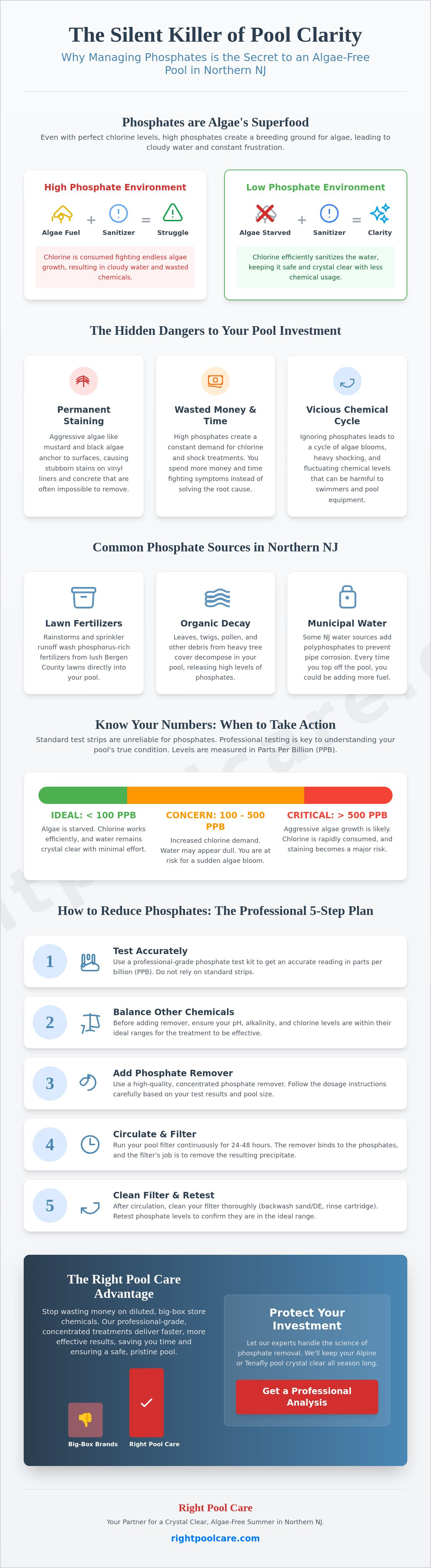
How to Reduce Phosphates in Your Pool: A 5-Step Action Plan
Removing high phosphate levels requires a systematic approach. If you miss a step, you are essentially pouring money down the skimmer. This is the Right Pool Care proven method for how to reduce phosphates in pool water effectively and permanently. Follow these steps to restore your water quality and protect your equipment.
- Step 1: Clean the pool of all organic debris. Use a leaf power vacuum or a heavy-duty net to remove every leaf, branch, and acorn. Organic matter constantly leaches phosphates into the water. You can't chemically fix a pool that is physically dirty.
- Step 2: Balance the water chemistry. Chemical efficacy depends on precision. Ensure your pH is between 7.2 and 7.4 and your total alkalinity is between 80 and 120 ppm. High alkalinity or out-of-range pH levels can neutralize the active ingredients in professional-grade removers.
- Step 3: Add a professional-grade phosphate remover. Skip the watered-down retail versions found at big-box stores. We use concentrated formulas that react instantly with dissolved orthophosphates. Pour the dose slowly around the perimeter or through the skimmer according to the manufacturer's directions.
- Step 4: Run the filtration system continuously. Keep your pump running for 24 to 48 hours. The remover binds to the phosphates to create a fine solid. Your filtration system must stay active to catch this material as it moves through the plumbing.
- Step 5: Clean or backwash the filter. Once the 48-hour cycle is complete, your filter will be loaded with "captured" phosphate dust. You must physically remove this from the system by backwashing your DE or sand filter, or by deep-cleaning your cartridges.
Pro-Tips for Maximum Efficiency
Don't add shock and phosphate remover at the same time. This can cause a heavy chemical precipitation that is difficult to clear. Expect a "milky water" phase during treatment. This cloudiness is a sign the chemical is working. If the water remains hazy after 24 hours, add a high-quality clarifier to help your filter grab those microscopic particles. This ensures your water returns to a "Miracles in the making" level of clarity.
Preventing Re-Entry in Alpine and Closter
Alpine and Closter properties often face unique challenges due to heavy tree canopies and sloped yards. Lawn runoff from local landscaping can spike your levels overnight. Install berms or improved drainage to keep nutrient-rich soil and fertilizer out of your water. A custom safety cover is your best defense during the off-season. It blocks the massive organic load that accumulates during Bergen County winters. Professional spring openings should always include a phosphate test to catch issues before the first June heatwave. We've seen levels jump by 500 ppb after a single heavy rainstorm in the Northern Valley area.
If your water still looks dull after treatment, you may need a professional deep-clean of your filtration system. Contact the Right Pool Care experts today to schedule a comprehensive water analysis and system tune-up.
Professional Management: Why Right Pool Care is the Best Choice for NJ Homeowners
Managing water chemistry is a complex science that goes beyond basic skimming. While many homeowners search for how to reduce phosphates in pool water using DIY methods, the results are often temporary. Right Pool Care brings a no-nonsense approach to Bergen County backyards. We're recognized as the Safety Cover Experts, but our team understands that total pool health begins with the molecular balance of the water. We don't just clear the water; we protect the structural integrity of your investment.
Professional-grade chemicals make a massive difference in long-term maintenance. Big-box stores often sell diluted products that require 30% more volume to achieve the same result as our professional concentrates. These fillers can actually contribute to total dissolved solids (TDS), making it harder to manage phosphates over time. By using high-potency treatments, we lower your chemical footprint and ensure your water stays crisp. This level of care translates directly into renovation savings. Preventing phosphate-driven algae blooms and scale today can save you $10,000 to $20,000 in premature liner replacements or plaster resurfacing down the road. It's a proactive strategy that keeps your backyard looking like one of our miracles in the making.
Expert Technical Services in Bergen County
Our technical team provides specialized services that standard cleaning companies can't match. We offer precision acid washing for pools suffering from severe phosphate-related staining. This process requires expert handling to restore the finish without compromising the material. We also integrate phosphate management into every seasonal opening and closing. This ensures your water is balanced before the first swim and remains stable through the winter. Our technicians also handle professional equipment repair. We ensure your filtration system and PVC piping are optimized to handle phosphate-removing media efficiently. The best way to understand how to reduce phosphates in pool systems is through this type of professional, mechanical analysis.
Schedule Your Water Analysis and Consultation
Right Pool Care brings 20 years of experience to every property we service. We provide local consultations in Alpine, Tenafly, and throughout Bergen County to help homeowners achieve beautiful, safe results. Our team doesn't offer quick fixes. We offer long-term solutions that prioritize safety and water clarity. Let our experts handle the technical details so you can enjoy your backyard without the stress of chemistry issues. We've seen every type of pool issue in New Jersey and know exactly how to fix it.
Take Control of Your Pool Chemistry Today
Maintaining a crystal-clear pool in Bergen County requires more than just a splash of chlorine. High phosphate levels serve as a constant food source for algae, which puts unnecessary strain on your filtration system and risks the long-term integrity of your vinyl liner. By following a structured 5-step action plan, you can effectively manage these levels and keep your water inviting. Understanding how to reduce phosphates in pool water is a vital skill for any homeowner looking to avoid the "green pool" nightmare during the humid 2026 summer months. Professional testing is essential because levels exceeding 1,000 ppb often require specialized chemical treatments that demand precision and care.
Right Pool Care offers 20+ years of local NJ experience to help you navigate these technical challenges. We're recognized as renovation specialists and safety cover experts who turn troubled waters into backyard masterpieces. Our team doesn't just clean filters; we create "miracles in the making" by ensuring your pool remains a safe and beautiful retreat for your family. Trust the experts who know North Jersey water best to handle your maintenance and liner care needs with professional authority and reliable results.
Get Expert Pool Care in Bergen County
Your perfect, algae-free swim season is ready when you are.
Frequently Asked Questions
Is it safe to swim in a pool with high phosphates?
It is generally safe to swim in a pool with high phosphates because these chemicals do not directly irritate human skin or eyes. However, phosphate levels exceeding 1,000 ppb act as a primary food source for algae, which can lead to rapid blooms. These blooms create slick surfaces and harbor harmful bacteria. If you see visible green growth, stay out of the water until the chemistry is balanced.
Can I use a phosphate remover if I have a saltwater pool?
You can and should use a phosphate remover in a saltwater pool. Keeping phosphates below 200 ppb is critical for salt systems because high levels can scale the salt cell plates. This scaling reduces chlorine production by 30 percent, forcing your generator to work harder. Using a remover ensures your salt cell operates at peak efficiency throughout the Bergen County summer.
How long after adding phosphate remover can I swim?
You should wait at least 30 minutes after adding the treatment before jumping back into the water. Most manufacturers require one full turnover of the pool water to ensure the product is distributed, which takes about 8 to 10 hours for a 20,000-gallon pool. If the water appears cloudy after the application, wait until the filter clears the debris and you can see the bottom clearly.
Why are my phosphates still high after using a remover?
Your levels may remain high if the initial concentration exceeded 2,500 ppb or if you're constantly adding new organic matter. Decaying leaves, local lawn fertilizers, and even heavy rain can introduce 500 ppb of phosphates in a single storm. If the reading doesn't drop, check your filter pressure. A dirty filter can't trap the precipitated phosphate particles effectively, leaving them in your water.
Does pool shock kill phosphates?
Pool shock does not kill or remove phosphates from the water. Chlorine shock is designed to kill living organisms like bacteria and algae, but phosphates are inorganic chemicals that remain even after the algae dies. To address the root cause, you must learn how to reduce phosphates in pool water using a lanthanum-based remover. This chemical binds to the phosphates so your filter can physically remove them.
How often should I test for phosphates in Bergen County?
Test your phosphate levels once every 30 days during the peak swimming season from May to September. Bergen County properties often have dense foliage and professional landscaping, which increases the risk of nutrient-rich runoff entering the water. If your town experiences more than 2 inches of rainfall in a 24-hour period, perform an extra test. Keeping levels under 100 ppb prevents 90 percent of algae-related service calls.
Will high phosphates turn my pool liner green?
Phosphates themselves won't stain your liner, but they trigger the aggressive algae growth that turns surfaces green. When levels are high, algae can double its mass every 4 to 6 hours. This rapid growth can lead to stubborn stains on a vinyl liner if it isn't treated within 48 hours. Right Pool Care experts recommend keeping chemistry balanced to protect your liner and keep your backyard looking like a miracle in the making.
What is the fastest way to lower phosphates naturally?
The fastest way to lower phosphates without heavy chemicals is to drain and refill a portion of the water. Replacing 25 percent of your pool water with fresh tap water can immediately drop phosphate levels by a corresponding percentage. Additionally, removing organic debris like leaves within 12 hours of them falling prevents them from breaking down. Knowing how to reduce phosphates in pool environments often starts with this simple, proactive debris management.