Last August, a homeowner in Ridgewood spent 14 hours scrubbing what they thought was simple debris, only to see the dark spots return even stronger 48 hours later. If you've noticed small, ink-colored specks on your surfaces, you're likely dealing with black algae in pool environments, a stubborn organism that builds a waxy, chlorine-resistant shell.
You're right to feel frustrated by all-purpose chemicals that fail and the fear of permanent stains on your expensive vinyl liner. At Right Pool Care, we specialize in miracles in the making, and that includes restoring the integrity of your backyard oasis. This 2026 expert guide gives you the professional-grade protocol to identify, eradicate, and prevent this resilient invader without damaging your masonry. We'll help you determine if you can tackle this DIY or if you need a trusted expert to save your season. You'll gain a clear strategy to stop the cycle of recurrence and keep your water pristine all summer long.
Key Takeaways
- Learn why this "super algae" is actually a rooted cyanobacteria and how its unique waxy coating protects it from standard chlorine treatments.
- Master the 5-step professional protocol to effectively eliminate black algae in pool surfaces while maintaining perfect water chemistry.
- Identify the role of phosphates and local Bergen County runoff in fueling outbreaks, and learn how to starve the algae at its source.
- Protect your investment with surface-specific cleaning techniques that prevent damage to delicate vinyl liners and porous masonry.
- Establish a "Clean In, Clean Out" routine to stop dormant spores from entering your pool via toys, suits, and seasonal equipment.
What is Black Algae? Identifying the 'Super Algae' in NJ Pools
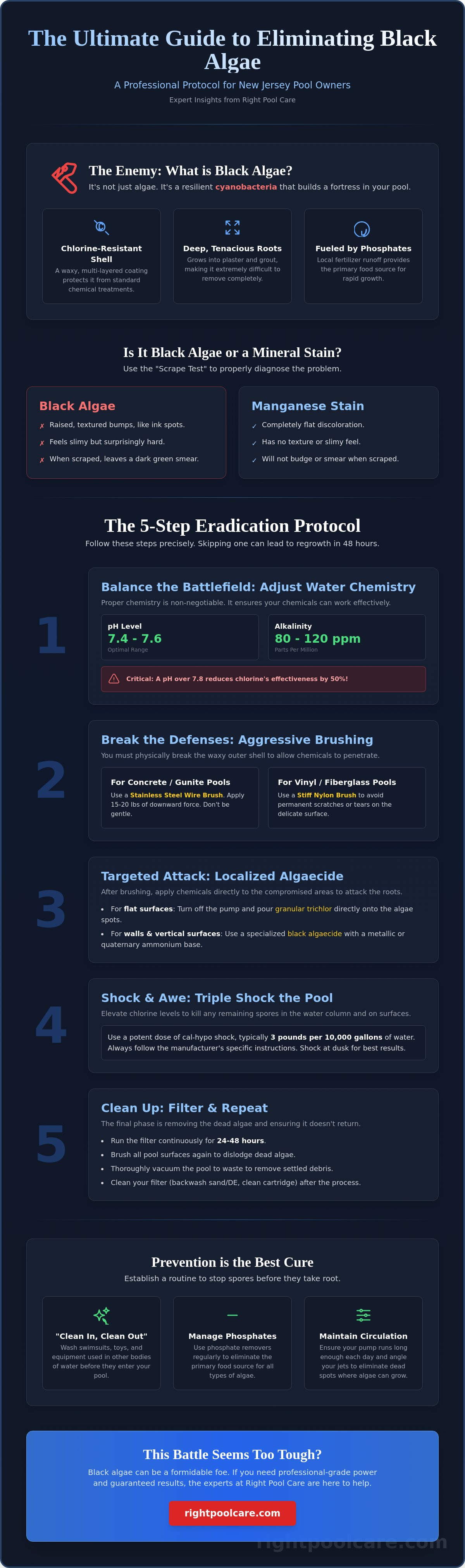
Black algae isn't actually algae. It's a form of cyanobacteria that creates a specialized protective barrier. To understand the broader category, many people ask What is Algae? and find that while they share similarities, this specific strain is far more resilient. This organism develops a waxy, water-resistant coating that prevents standard chlorine levels from reaching its core. Unlike the floating green variety, black algae in pool finishes grows deep roots into the plaster or grout. This makes it one of the most difficult contaminants to eradicate without professional help. At Right Pool Care, we view every restoration as one of our miracles in the making, turning a compromised backyard back into a safe sanctuary.
You'll notice small, dark spots about the size of a pin-head. They look like black or deep blue-green specks. If you touch them, they feel slimy but remain surprisingly hard. Homeowners in Closter can perform the "scrape test" to confirm the diagnosis. Use a flathead screwdriver or a stiff brush to scratch the surface of a spot. If it comes off as a dark green smear on your fingernail or tool, it's organic growth. If it doesn't budge, you're likely looking at a mineral stain. This simple check saves time and ensures you're applying the right treatment for your specific surface.
Why Northern New Jersey Pools are Susceptible
Bergen County humidity often hits 75% or higher during July and August. This moisture creates a breeding ground for airborne spores that settle in your water. In towns like Alpine and Tenafly, heavy landscaping is a standard feature of luxury properties. Runoff from high-phosphate fertilizers often enters the water, providing the primary food source for these bacteria. High-porosity concrete and aging vinyl liners provide the perfect foothold for these roots to take hold and spread rapidly.
Common Misidentifications: Algae vs. Manganese Stains
NJ well water often contains high levels of manganese. These mineral deposits create dark, brownish-black spots that look similar to biological growth. However, mineral stains appear as flat discolorations rather than raised, textured bumps. Standard stain removers might lift manganese, but they won't touch a biological colony. Black algae is a multi-layered organism that requires mechanical disruption to kill. Identifying black algae in pool plaster early is the only way to prevent a full-scale takeover that requires an acid wash or liner replacement.
The Professional Removal Protocol: 5 Steps to Eradicate Black Algae
Treating black algae in pool systems isn't a standard maintenance task; it's a surgical operation. This organism creates a multi-layered defense mechanism including a waxy outer coating that repels standard chlorine levels. To ensure total eradication, you must follow a strict five-step protocol that prioritizes chemistry and mechanical force. Skipping even one step often results in the algae returning within 14 days.
Step 1 & 2: Balancing and Brushing
Success begins with water chemistry. You must adjust your pH to a range between 7.4 and 7.6 and keep alkalinity between 80 and 120 ppm. When pH exceeds 7.8, chlorine loses approximately 50% of its efficacy, making it impossible to kill deep-seated spores. Once balanced, you move to mechanical disruption. This is the most physically demanding part of the process.
- Concrete or Gunite: Use a stainless steel wire brush to aggressively scratch the algae heads.
- Vinyl or Fiberglass: Use a stiff nylon brush to avoid tearing the liner or scratching the gel coat.
The "Pressure Technique" involves applying 15 to 20 pounds of downward force to ensure you've broken the protective waxy cap. This exposure is vital because the health implications of cyanobacteria, which black algae belongs to, make it a risk for swimmers if left untreated. You're not just cleaning; you're disinfecting a biological hazard. Every spot must be visibly scratched to allow chemicals to reach the core.
Step 3 & 4: Chemical Warfare and Shocking
After brushing, apply localized treatments. For flat surfaces in Demarest residential pools, you can pour granular trichlor directly onto the spots. For walls, use a specialized black algaecide with a metallic or quaternary ammonium base. These formulas are designed to penetrate the remaining root systems that have burrowed into the plaster. If you're unsure about the structural integrity of your plaster during this process, it's wise to consult a trusted pool renovation expert.
The "Triple-Shock" comes next. You need to raise your chlorine levels to 30 ppm, which is roughly three times the standard shock dose. This overwhelming concentration floods the exposed cells. Don't stop there. Execute the "Double-Tap" method by brushing the entire pool again 24 hours after the initial shock. This second scrubbing reaches the secondary layers of the colony that the first round might have missed.
Finally, run your filtration system for 48 consecutive hours. Dead spores will cloud the water, and your filter must capture them to prevent a re-infestation later in the season. Clean or backwash your filter once the pressure rises 8 to 10 PSI above its clean starting point. This ensures no viable spores remain in the plumbing to start the cycle over again.
Beyond Chlorine: Why Phosphates and pH Matter for Algae Removal
Chlorine is your primary weapon, but it isn't a silver bullet. If you're struggling with black algae in pool surfaces, the root cause often lies in the water's nutrient levels. Phosphates act as a high-octane fuel for cyanobacteria. These compounds enter your water through various environmental factors common in Northern New Jersey. When phosphate levels exceed 500 parts per billion (ppb), algae growth accelerates beyond what standard chlorine doses can manage.
Local environmental conditions play a massive role. In Bergenfield and surrounding areas, heavy spring rains often wash nitrogen-rich lawn fertilizers and decaying organic matter directly into backyard basins. This runoff creates a nutrient spike that bypasses your filtration system. High pH levels complicate the problem further. When your pH climbs above 7.8, your free chlorine loses nearly 70% of its sanitizing power. This lazy chlorine can't penetrate the protective waxy coating of black algae, allowing the colony to dig deep into your plaster or grout.
Managing Phosphates in Bergen County
Eliminating the food source is the fastest way to starve an outbreak. We recommend using commercial-grade phosphate removers to bring levels down to near zero. Local sources of contamination include runoff from manicured lawns and the heavy leaf fall typical of Bergen County autumns. You must understand that chlorine alone cannot stop algae if the phosphate 'buffet' is still open. Regular maintenance prevents these nutrients from accumulating to dangerous levels.
- Test for phosphates monthly during the peak swimming season.
- Clear organic debris immediately after heavy summer storms.
- Use a specialty flocculant to drop suspended nutrients to the floor for vacuuming.
The Chemistry of Prevention
Maintaining specific 2026 water chemistry standards is the best defense for Northern NJ pools. Aim for a pH between 7.2 and 7.4 to keep chlorine aggressive. Keep calcium hardness between 200 and 400 ppm. Low calcium levels cause the water to become aggressive, etching the pool surface and creating microscopic pits where black algae in pool walls can anchor securely. If your pool surface has already suffered from years of chemical imbalances, it might be time for a professional update. Check our Swimming Pool Renovation Guide for Bergen County to see how a new finish can prevent future infestations.
Weekly testing costs roughly $10 per month in reagents but saves thousands in remediation. A single black algae treatment often requires multiple acid washes and intensive scrubbing. Professional maintenance ensures your water remains a hostile environment for spores while protecting your structural investment. By balancing your chemistry, you turn your pool from a petri dish into a pristine retreat.
Vinyl vs. Concrete: Protecting Your Pool Surface During Treatment
The most common objection homeowners raise is the fear of physical damage. You might worry that scrubbing hard enough to kill black algae in pool surfaces will leave permanent scars or tears. It's a valid concern because the wrong tool on the wrong surface leads to expensive repairs. Scrubbing is non-negotiable, but your technique must respect the material of your pool.
For vinyl liners, stainless steel wire brushes are strictly prohibited. These aggressive bristles can puncture a standard 20-mil or 27-mil liner in seconds, leading to immediate leaks. You must use "liner-safe" nylon or poly-bristle brushes. These provide enough friction to disrupt the algae's protective layer without compromising the vinyl's integrity. Concrete and gunite pools require the opposite approach. If you don't use a heavy-duty wire brush, you won't reach the roots. If left for more than 12 months, black algae can actually pit the masonry, creating deep pockets that make future outbreaks 60% more likely.
The Vinyl Liner Specialist Perspective
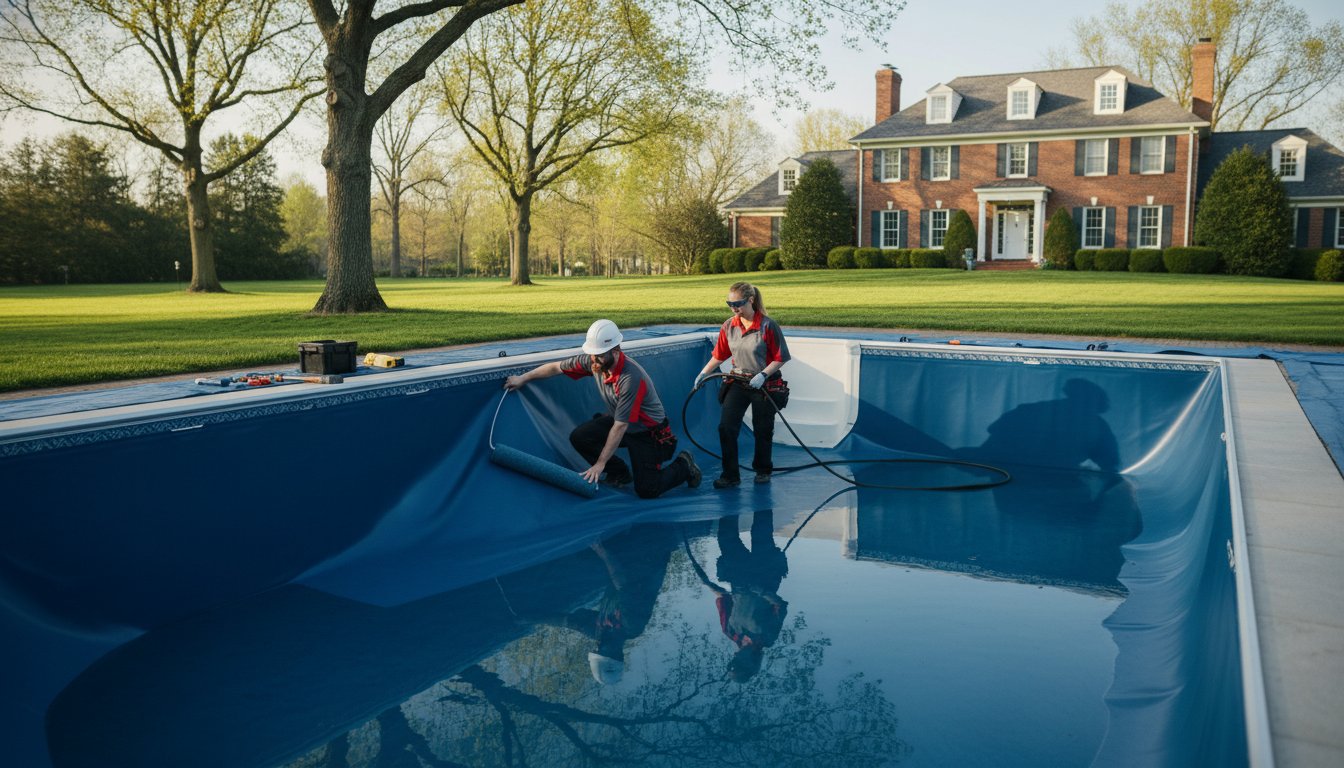
Vinyl requires a specialized touch. Sometimes, what looks like black algae in pool corners is actually growth happening behind the liner. This occurs when groundwater or leaks trapped between the wall and the vinyl create a breeding ground. If the spots don't budge after a localized chlorine rub, the liner likely needs a full replacement. Be cautious with high-dose chlorine treatments; levels exceeding 30 ppm can bleach patterns and make the material brittle. If your surface is already compromised, check out our guide on Expert Pool Liner Replacement to see if a fresh start is necessary.
Concrete Resurfacing and Acid Washing
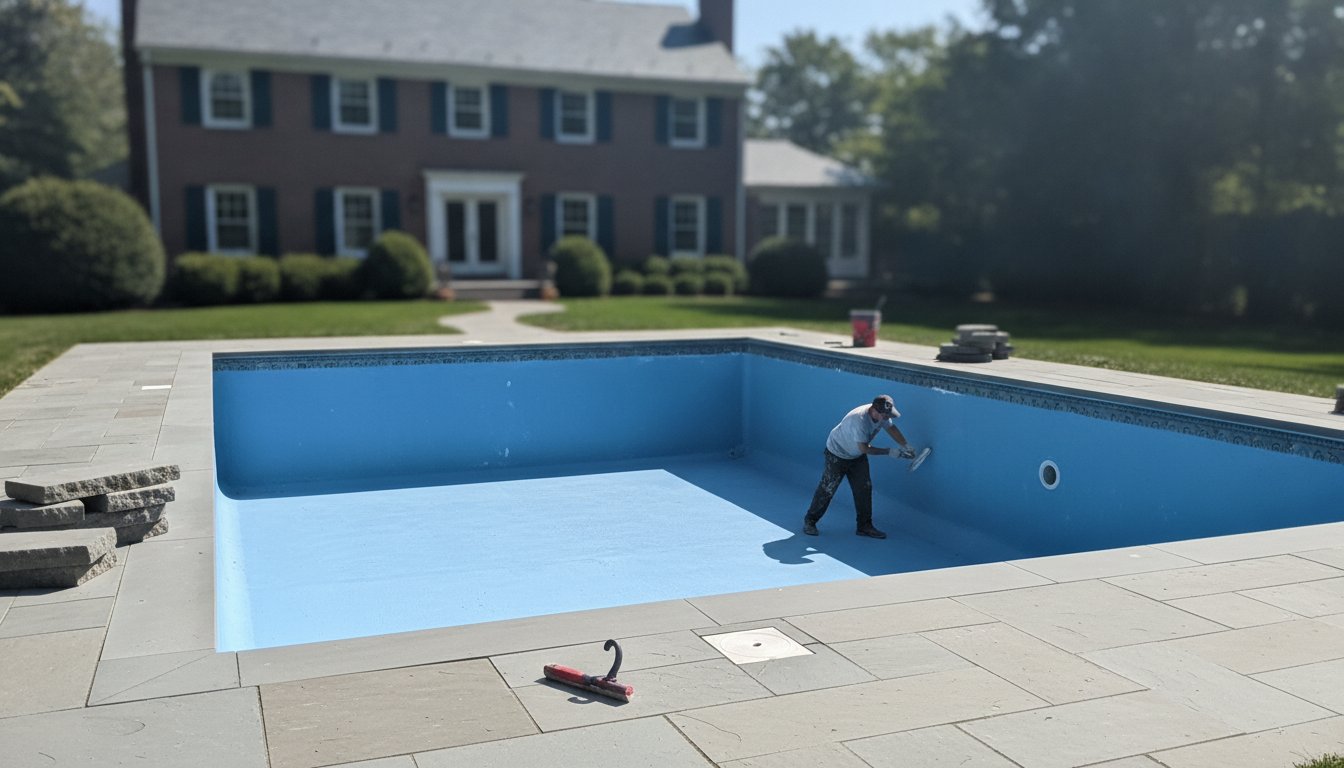
When plaster becomes a magnet for algae, a professional acid wash is often the only solution. This process uses a precise mixture of muriatic acid to strip a microscopic layer of the concrete, physically removing the embedded roots. If your pool floor feels like 60-grit sandpaper, it's already pitted. Right Pool Care performs "Miracles in the making" by resurfacing these aged shells. A new, smooth finish doesn't just look better; it removes the hiding spots where algae spores cling, making your weekly maintenance significantly easier.
Stop guessing and start protecting your investment. Contact Right Pool Care for a professional surface assessment and custom treatment plan.
Preventing Future Outbreaks in Closter and Bergenfield Homes
Stopping black algae in pool surfaces requires more than just a one-time treatment. It demands a proactive strategy tailored to the Bergen County climate. The "Clean In, Clean Out" rule is your first line of defense. Black algae spores are microscopic hitchhikers often brought in from the Jersey Shore or local lakes. If your swimsuits, life vests, or inflatable toys have touched natural bodies of water, wash them in hot water and bleach before they enter your pool. This simple step prevents external contaminants from taking root in your plaster or liner.
Seasonal vigilance is equally vital. Professional pool openings and closings are not just about moving water. They are about neutralizing dormant spores that survive the winter. During the off-season, a custom safety cover provides a significant advantage. Unlike standard tarps, these covers prevent organic debris from entering the water. Leaves and twigs create a nutrient-rich "tea" that fuels algae growth. By keeping the water clean and dark, you starve the algae before the spring sun hits.
Many NJ homeowners attempt a DIY chemical dump when they spot a dark stain. This often backfires. Excessive chlorine can bleach your liner or damage your heater without reaching the deep roots of the algae. Professional intervention ensures the chemistry is balanced to kill the roots, not just the surface bloom.
Professional Maintenance Schedules
Weekly professional skimming and chemistry checks are the standard for luxury properties in Alpine and Norwood. Right Pool Care technicians identify "hot spots" like stagnant corners or rough patches in the plaster where black algae in pool walls often begins. We monitor phosphate levels and stabilizer ratios to keep your sanitizer effective. During the humid NJ July and August, we recommend filtration run-times of at least 10 to 12 hours. Stagnant water is an invitation for an outbreak. Moving water stays clear water.
The Right Pool Care Difference
Local experience matters because Bergen County has unique soil and weather patterns that affect water chemistry. We are not just service providers; we are "Safety Cover Experts" dedicated to protecting your investment. Our team focuses on "Safe Step" and equipment repairs that eliminate the tiny cracks where algae hides. We believe in "Miracles in the making," transforming high-stress pool problems into pristine backyard retreats. Don't wait for a small spot to become a total renovation project. Schedule a professional pool inspection or renovation consultation today to keep your water crystal clear all season long.
Restore Your Pristine Bergen County Oasis
Dealing with black algae in pool structures requires more than a simple shock treatment; it demands a professional 5 step eradication protocol. You've learned that maintaining a precise pH balance and eliminating phosphates are the only ways to prevent these deep rooted spores from returning to your water. Whether you're protecting a custom vinyl liner or specialized masonry, using the right chemical balance is critical to avoid permanent surface etching or bleaching during the 2026 season.
Don't let a stubborn outbreak compromise your home's value. Right Pool Care brings over 20 years of local NJ experience to every project. As specialists in both vinyl liner replacement and professional masonry restoration, we understand the specific water chemistry challenges faced by homeowners in Alpine, Closter, and Tenafly. We've spent two decades perfecting the art of pool recovery, turning stressed backyards into miracles in the making with reliable, expert service.
Trust the Bergen County Experts to Restore Your Pool—Contact Right Pool Care Today
Your clear, sapphire water is just one professional treatment away. We're ready to help you reclaim your summer.
Frequently Asked Questions
Is black algae in a pool harmful to swimmers?
Yes, black algae harbors dangerous bacteria like E. coli and Pseudomonas within its layers. According to CDC data from 2023, 1 in 10 pool inspections resulted in immediate closure due to serious health risks like these. The growth also creates a severe slip hazard on steps and floors. Right Pool Care recommends closing the water until the bloom is fully eradicated to prevent skin infections or accidents.
Can I use a pressure washer to get rid of black algae?
You shouldn't use a pressure washer because it often causes permanent damage to your pool finish. High-pressure streams exceeding 3,000 PSI can pit pool plaster or tear a vinyl liner. While it might blast away the surface cap, the roots remain embedded in the porous walls. Our experts use specialized steel brushes and targeted chemical treatments to reach the source without compromising your pool's structural integrity.
How long does it take to completely kill black algae?
Eradicating black algae in pool surfaces typically takes 7 to 10 days of consistent treatment. This timeline includes at least 3 separate rounds of aggressive scrubbing and triple-dose chlorine shocking. Because this species has a waxy protective layer, you can't rush the process. Skipping even one day of treatment allows the roots to regrow, potentially extending the total recovery time to 14 days or longer.
Why does black algae keep coming back even after I shock the pool?
Black algae returns because its roots penetrate up to 0.25 inches into porous pool surfaces like plaster or grout. Standard shocking fails if you don't physically break the waxy protective coating first. If the roots remain, the bloom will reappear within 5 to 7 days. At Right Pool Care, we emphasize that mechanical scrubbing is the only way to ensure the chlorine actually reaches the living organism.
Will black algae ruin my vinyl pool liner permanently?
It won't usually eat through the vinyl, but it causes permanent cosmetic damage through deep staining. If left untreated for more than 30 days, the pigment can migrate into the liner material itself, making it impossible to clean. In these cases, a full liner replacement is the only solution. Right Pool Care specializes in these transformations, turning stained eyesores into miracles in the making for your backyard.
What is the best algaecide for black algae in 2026?
The most effective treatment in 2026 remains a high-quality copper-based algaecide with a 30 percent concentration. For localized spots, we use 90 percent granular Trichloro-s-triazinetrione directly on the affected area. This concentrated approach ensures the chemical stays in contact with the roots. We always recommend testing your water first to ensure your saturation index is balanced, which prevents these chemicals from causing secondary metallic stains.
Can black algae grow in a saltwater pool?
Yes, black algae in pool environments can thrive even if you have a saltwater system. Saltwater pools rely on a chlorine generator to maintain a 1 to 3 ppm chlorine level, which is often insufficient to kill a stubborn black algae bloom. A salt concentration of 3,200 ppm does nothing to stop growth. You must still manually scrub the spots and use supplemental shocking to eliminate the infestation completely.
Does high phosphate really cause black algae?
High phosphate levels don't cause the algae, but they act as a high-octane fuel source that accelerates its growth. When phosphate levels exceed 500 parts per billion (ppb), algae can reproduce at twice its normal rate. Reducing phosphates makes your chlorine more effective and helps prevent future outbreaks. Right Pool Care technicians always test for phosphates during our initial assessment to ensure your water remains clear and safe.