Spending $800 to patch up a decade-old heater isn't a smart repair. It's often just a down payment on a machine that's already failing you. When your pool stays cold during the short New Jersey swimming season, the pressure to make a quick decision is intense. You're likely weighing the immediate repair vs replace pool heater cost while staring at technical jargon like BTUs and heat exchangers. It's a stressful position for any Bergen County homeowner who values both comfort and financial logic.
We understand that you want reliability without the anxiety of escalating utility bills or recurring breakdowns. This guide provides a definitive "Go/No-Go" rule for 2026 to determine if your equipment is worth saving. You'll learn why the 50 percent rule is the gold standard for savvy homeowners and how to identify components that signal a total system failure. We're here to help you master the financial logic of your pool equipment so you can invest in long-term performance instead of temporary fixes.
Key Takeaways
- Apply the "50% Rule" to decide if fixing an aging unit is a strategic investment or a financial mistake.
- Master the financial logic behind the repair vs replace pool heater cost by comparing immediate fixes to the long-term ROI of modern upgrades.
- Identify why major failures in heat exchangers or control boards often signal that your unit has reached its terminal lifespan.
- Learn how New Jersey's unique climate influences equipment longevity and the necessity of high-efficiency performance.
- Discover how 2026 efficiency standards can significantly reduce your monthly heating expenses compared to older equipment.
The Financial Crossroads: Repairing vs. Replacing Your Pool Heater
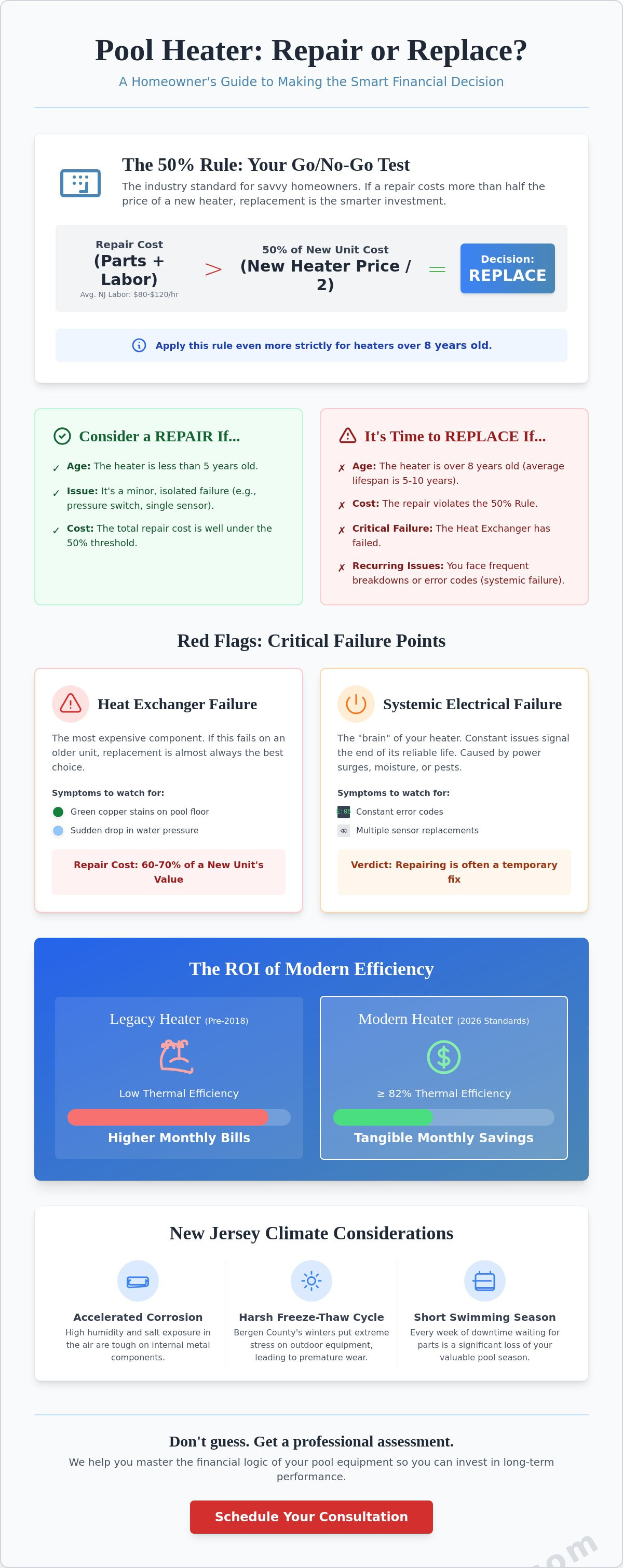
New Jersey homeowners often find themselves at a difficult financial crossroads when a pool heater fails in mid-June. The dilemma isn't just about the immediate bill; it's about the long-term logic of your investment. Deciding on the repair vs replace pool heater cost requires a cold, hard look at the "50% Rule." This industry standard suggests that if a single repair exceeds half the price of a brand-new unit, you're better off upgrading. Northern New Jersey’s humidity and salt exposure accelerate internal component corrosion, often turning a small leak into a catastrophic failure. In Bergen County, where the freeze-thaw cycle is particularly harsh on outdoor equipment, an older unit becomes a liability rather than an asset.
Understanding the 50% Rule
Calculating this threshold involves more than just the parts invoice. You must factor in professional labor, which in the NJ area typically ranges from $80 to $120 per hour as of 2026. If your heater is over eight years old, the 50% rule should be even more strictly applied. Gas heaters generally have a lifespan of 5 to 10 years; once you hit that eight-year mark, internal components like the heat exchanger are likely nearing terminal failure. There is also a significant "nuisance factor" to consider. Every week your heater sits idle while waiting for specialized parts is a week of the short NJ swimming season lost. Nursing a failing machine often leads to a cycle of repeated service calls that quickly eclipse the price of a modern replacement.
The Opportunity Cost of Inefficiency
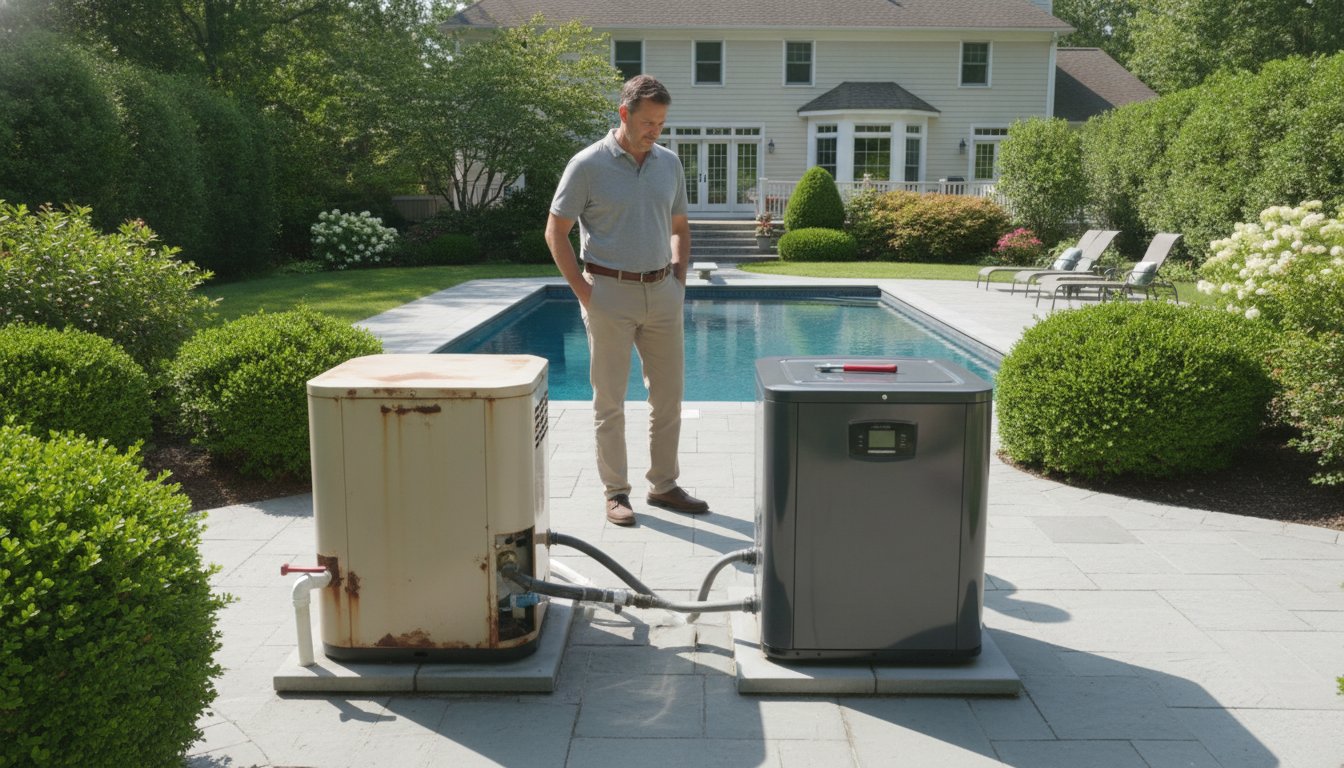
Older heaters manufactured before the 2018 efficiency shifts are essentially bleeding money every time they ignite. These legacy units often operate at significantly lower thermal efficiency than modern counterparts. Thermal efficiency is the ratio of energy transferred to the pool water compared to the total energy consumed by the heater; higher percentages mean lower monthly gas bills for your home. While a repair might get an old unit running, it won't fix the underlying design that consumes excessive fuel. By investing in modern heat pump technology or high-efficiency Low NOx gas heaters, you align your property with current 2026 standards, such as the 82% minimum thermal efficiency requirement. This shift doesn't just lower your carbon footprint; it provides a tangible return on investment through reduced monthly operating costs that a simple repair can't match.
Evaluating Repair Costs: Common Failures and Their Price Tags
Identifying the specific failure in your system is the first step toward calculating the repair vs replace pool heater cost. In Bergen County, many heater issues stem from neglected water chemistry. High acidity or improper pH levels can eat through metal components in a single season. When the internal mechanics begin to fail, you're often facing a choice between a complex restoration and a total system upgrade. Some repairs are routine maintenance; others are clear indicators that your equipment has reached the end of its reliable life.
The Heat Exchanger: The Heart of the Matter
The heat exchanger is the most critical and expensive component inside your heater. It's responsible for transferring heat from the flame or compressor to your pool water. If you notice green copper stains on your pool floor or a sudden drop in water pressure, your exchanger is likely leaking. Replacing this part is an intensive process. It often accounts for 60 to 70 percent of the total value of a new unit. When an exchanger fails on a heater older than five years, a professional pool repair might only buy you a few more months of service. It’s a major investment that rarely makes sense for an aging system.
Electrical and Sensor Failures
Modern heaters rely on sophisticated control boards and sensors to maintain safety and efficiency. These electronics are the "canary in the coal mine" for your system. New Jersey’s frequent summer thunderstorms and power surges can fry sensitive circuitry instantly. While replacing a single pressure switch or thermal regulator is a minor fix, a full control board replacement is a different story. If you're constantly clearing error codes or replacing multiple sensors, it's a sign of systemic electrical failure. In these cases, looking into the long-term energy savings with a heat pump is often the smarter financial move. These modern units offer superior reliability and lower operating costs compared to repairing a legacy system.
Rodent damage is another common issue for NJ homeowners. Mice often nest in the insulation of heaters during the winter, chewing through wires and creating fire hazards. This damage is frequently extensive and compromises the safety of the entire unit. Before committing to a costly overhaul, a Right Pool Care expert assessment can help you determine if your heater is safe to operate or if it’s time to retire the equipment for a more secure, modern model.
The Case for Replacement: Modern Efficiency and ROI
Investing in a total upgrade is often the most logical financial move for Bergen County properties. While a repair might keep a 10-year-old unit limping along, it won't address the compounding costs of outdated technology. When evaluating the repair vs replace pool heater cost, you must look at the total cost of ownership over the next five to ten years. A new installation provides a fresh warranty and a reset on the equipment's lifecycle, eliminating the fear of another major part failure next season. Modern units deliver a level of reliability and fiscal performance that legacy machines simply cannot match.
Energy Savings and Environmental Impact
Today’s top-tier condensing gas heaters can reach up to 95% thermal efficiency. This is a massive leap from the traditional gas heater efficiencies often found in units installed a decade ago, which may have dropped as low as 70% due to age and scale buildup. In New Jersey, where utility prices can be volatile, this efficiency gap directly translates into hundreds of dollars in annual savings. Additionally, modern Low NOx heaters are now the industry standard. These units significantly reduce nitrogen oxide emissions to meet local environmental regulations. This isn't just about being green; it’s about ensuring your home remains compliant with evolving state codes while enjoying a much faster "payback period" through reduced monthly gas consumption.
Automation and Smart Features
Convenience is a major pillar of the 2026 pool experience. Modern heaters integrate seamlessly with smartphone automation, allowing you to ignite the burner and set the perfect temperature before you even leave the office. These systems also feature advanced self-diagnostics that alert you to minor issues, such as airflow obstructions or sensor drift, before they become catastrophic failures. If you are already planning a swimming pool renovation, upgrading your heater at the same time ensures your entire equipment pad is synchronized for maximum performance. This proactive approach guarantees that your pool is always ready for a swim, backed by the security of a comprehensive manufacturer warranty that covers both parts and professional labor.
The Northern NJ Decision Matrix: Age, Usage, and Climate
In Bergen County, the environment is often the primary driver of the repair vs replace pool heater cost equation. Unlike warmer climates where heaters might run year-round, our equipment sits dormant through freezing winters and humid springs. This seasonal cycle creates unique stress points that national averages simply don't account for. Homeowners in Closter, Alpine, and Tenafly frequently deal with the physical toll that Northern New Jersey's weather takes on internal piping and burner trays. Understanding these local variables helps you decide whether a quick fix will actually hold up against the next freeze or if you're just delaying the inevitable.
Climate Factors in Bergen County
Improper winterization remains the leading cause of premature heater failure in our region. If even a small amount of water remains in the header during a deep freeze, the resulting expansion can shatter the internal manifold. High summer humidity also plays a role; it causes condensation to form inside the cabinet, which leads to rusted burner trays and compromised ignition systems. The extreme temperature swings of Northern NJ winters cause copper heat exchangers to expand and contract rapidly, often resulting in microscopic cracks that lead to terminal leaks. These structural issues are rarely worth repairing because the core integrity of the entire unit has been compromised by the elements.
The 8-12 Year Benchmark
While some well-maintained units may last longer, 10 years is the magic number for most residential gas heaters in New Jersey. By this point, the efficiency has likely degraded, and the cost of parts starts to climb. If you're a "weekend warrior" who only heats the pool for Saturday gatherings, a gas heater’s quick recovery time is essential. However, daily swimmers often find better long-term value in heat pumps, which boast a lifespan of 10 to 20 years in our region. Your water source also matters; well water in certain parts of Bergen County can be high in minerals that cause scale buildup, while municipal water requires strict chemical balancing to prevent acidity from eating the heater's copper internals. If your unit is hitting the decade mark and showing heavy exterior rust, it's time to stop patching and start upgrading.
Don't let a failing heater cut your swimming season short. If you're unsure about the state of your equipment, contact us for a professional Equipment Repair and Replacement evaluation to get a no-nonsense verdict on your system's health.
Professional Equipment Solutions with Right Pool Care
Choosing the right path for your pool heating system shouldn't be a guessing game. At Right Pool Care, we provide a no-nonsense assessment to help you navigate the repair vs replace pool heater cost with total clarity. We don't believe in band-aid fixes for equipment that has reached its terminal stage. Our priority is delivering high-efficiency, reliable solutions that stand up to the specific demands of the New Jersey climate. We analyze your current system's age, performance history, and structural integrity to give you a definitive recommendation based on long-term value rather than a quick sale.
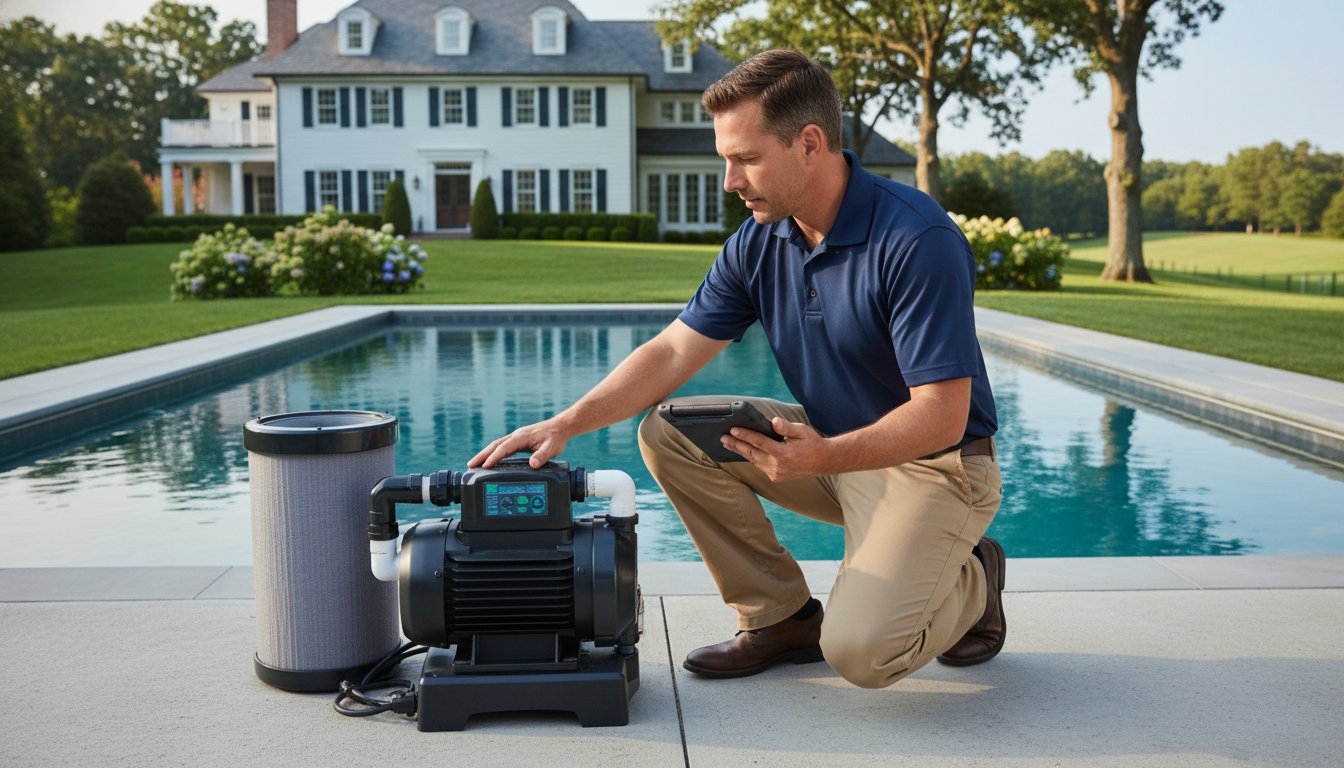
Professional sizing is a critical part of our process. A heater that is too small for your pool volume will run constantly, leading to premature mechanical failure and astronomical utility bills. Conversely, an oversized unit wastes energy and cycles too frequently. We ensure your new equipment is perfectly calibrated for your specific pool size and usage patterns. This precision extends to our installation process, where we prioritize safety in every gas and electrical connection. Integrating a new heater into your seasonal maintenance plan ensures that your investment remains protected through every opening and closing cycle.
The Right Pool Care Difference
With over 20 years of experience in Bergen County’s unique pool landscape, we've seen every possible equipment failure. We only recommend "Tier 1" manufacturers known for their longevity and parts availability. This commitment to quality ensures that your heater isn't just a utility; it is a reliable component of a beautiful, life-enhancing outdoor space. Our technicians are organized, detail-oriented, and committed to safety standards that exceed local codes. We take pride in transforming problematic equipment pads into streamlined, high-performance systems that give you peace of mind.
Next Steps for Your Pool
If your heater is struggling to reach temperature or making unusual noises, don't wait for a total breakdown. Scheduling a professional diagnostic is the most effective way to protect your swimming season. Before our team arrives, ensure your equipment pad is clear of debris and that we have easy access to your gas and electrical shut-offs. We will provide a comprehensive report on your unit's health and a clear path forward for either a durable repair or a modern upgrade. Contact Right Pool Care today for a professional equipment assessment.
Secure Your Season with a High-Performance Heating Strategy
Mastering the financial logic of your pool equipment ensures that every dollar spent is an investment in your home's value. You now have the framework to decide if a repair provides true value or if a modern upgrade is the only way to secure long-term reliability. By focusing on thermal efficiency and the unique stressors of the Bergen County climate, you can eliminate the anxiety of rising utility bills and unexpected mid-season breakdowns. Navigating the repair vs replace pool heater cost doesn't have to be a source of frustration when you prioritize performance over temporary fixes.
Right Pool Care stands as an established leader with over 20 years of Bergen County expertise. We are specialists in high-efficiency equipment and serve as authorized installers for the industry's leading brands. Our no-nonsense approach cuts through technical jargon to provide a clear path toward a warm, inviting pool. Don't let an aging system dictate your comfort. Request a Professional Heater Diagnostic from Right Pool Care today to transform your equipment pad into a model of modern efficiency. We look forward to helping you create a beautiful, worry-free swimming experience for your family.
Frequently Asked Questions
How much does it typically cost to repair a pool heater in 2026?
Industry data for 2026 shows an average repair cost of $479, with most homeowners paying between $166 and $803. These figures fluctuate based on the specific component and the hourly labor rates of local NJ professionals. When calculating the repair vs replace pool heater cost, remember that major fixes like heat exchangers can exceed $2,000. This often makes a total upgrade the smarter financial move for aging systems.
How long should a gas pool heater last in New Jersey?
A residential gas pool heater in New Jersey typically lasts between 5 and 10 years. Our harsh Bergen County winters and high humidity levels can accelerate internal corrosion if the unit isn't winterized perfectly. While some well-maintained units might push past a decade, the eight-year mark is usually when efficiency drops and mechanical failures become more frequent and expensive to address.
What are the signs that my pool heater heat exchanger is failing?
Green copper stains on your pool floor or a noticeable drop in water pressure are the primary indicators of a leaking heat exchanger. You might also see water pooling beneath the heater cabinet or soot buildup on the burner tray. Since this component is the most expensive part of the system, its failure usually signals that the unit has reached the end of its viable life.
Is it cheaper to run a heat pump or a gas heater in Bergen County?
Electric heat pumps are significantly cheaper to operate during the peak summer months, with monthly costs often ranging from $40 to $200 compared to $200 to $400 for gas. However, gas heaters are more effective during the shoulder seasons of April and October when air temperatures drop below 50 degrees. Your choice depends on whether you value low monthly bills or a longer swimming season.
Can I replace my own pool heater or do I need a professional?
You must hire a licensed professional for pool heater replacement to comply with the New Jersey Uniform Construction Code. Installations involve complex gas line connections, high-voltage electrical wiring, and precise plumbing that pose significant safety risks if handled incorrectly. Most manufacturers will also void your warranty if the equipment isn't installed by a certified contractor who understands the mechanics of the craft.
Does a new pool heater increase the value of my home?
A modern, high-efficiency heating system adds tangible appeal and value to a North Jersey property. Prospective buyers in Bergen County view updated pool equipment as a sign of a well-maintained home and appreciate the promise of lower utility costs. It transforms the pool from a potential maintenance liability into a turnkey luxury feature, making your property stand out in a competitive real estate market.
What happens if I don’t repair my pool heater right away?
Delaying a repair can lead to catastrophic damage to other pool components, such as your pump or filter, due to soot buildup or internal leaks. Small issues like a faulty pressure switch can mask larger safety concerns that eventually lead to a total system failure. Addressing problems early prevents minor fixes from escalating into a much higher repair vs replace pool heater cost later in the season.